
Our community has been perennially confused about exactly when to switch back from the Easter Season's "Regina Coeli" to the Ordinary Time Angelus. Technically, the Easter Season ended last Sunday, but there is a tradition that ekes it out just a few days more by continuing to pray the Regina Coeli until Trinity Sunday. Somewhere recently I read that the Regina Coeli is said up to and including the afternoon of Trinity Sunday.
Either way, it's time to look again at the Angelus. Calling the Incarnation to mind three times a day is a terrific way to keep your spiritual life in tune, and I think it is a kind of secret for the new evangelization as well. Three times a day, you affirm your faith in God's deeply personal interest in humanity. Three times a day, you recall humanity's profound response, given in Mary. Three times a day, in other words, you recommit to the Gospel.
Not, as St. Paul said, that we have anything to boast of: The initiative is entirely from God, it is pure gift. But there is a response, which is also a genuine gift given back to the source. The Annunciation follows the usual biblical “call” pattern—but with one really big difference. Mary is the only person in the whole Bible to give her own verbal consent to an announcement from God. She says she is God’s “slave,” but she acts as a freewoman and child of God. So we have God’s initiative and then the creaturely response.
The Angelus shows us what our Founder wrote decades ago: "Everything comes from God-beginning, to return to God-end: for his glory and the happiness of all people."
Saturday, May 29, 2010


Friday, May 28, 2010
Equality, Distinction and TOB
In community, we've been talking about ways to present the Theology of the Body to Church people whose passions are especially focused around justice issues, and who many times just don't seem to "get" Theology of the Body. I came across an interesting passage from Thomas Merton (from his
last journals ; I think this passage is from 1963) that I think expresses exactly the issue. In Merton's day, he was watching the rapid changes in his Trappist community, changes presumably inspired by Vatican II (which had only begun the year before). He wrote about the integration of the brothers with the "choir" monks, giving them white habits in place of their distinctive brown ones in the name of unity:
 about the connection between complementarity and unity; Schmemann is the one who really makes the connection between Merton's insight and the Theology of the Body (although John Paul II had not even been elected Pope, and the world had not heard the expression "Theology of the Body" when Schmemann penned this in 1976 (emphasis in original):
What I think happens in some justice circles is that "equality" begins to assume a kind of mathematical character, making anything but juridical "identicalness" an injustice. But the complementarity built into our nature for all to see is really the greatest hope of a truly human justice rooted not in individualism, but in unity. And I love that the Gethsemane Trappist and the Russian emigre give us the language with which to begin to assess the language and goals we use in the pursuit of justice.
last journals
; I think this passage is from 1963) that I think expresses exactly the issue. In Merton's day, he was watching the rapid changes in his Trappist community, changes presumably inspired by Vatican II (which had only begun the year before). He wrote about the integration of the brothers with the "choir" monks, giving them white habits in place of their distinctive brown ones in the name of unity:"I think the difference in habit, as the difference in schedule and matter of life between the two groups, had a profound importance for unity. Psychologically and spiritually the effect of 'complementarity' one --of two groups need one another, completing one another by definite and useful functions, had and has a great deal of meeting both for brothers and choir. It made possible a sense of relationship, of mutual interdependence, which had great significance for unity. It produced an organic unity, living.Which is being replaced by juridical unity, a unity on paper. At a certain seems that the whole thing will go further and that the two lives will be reduced to uniform observance, with the brothers more and more involved in choir and withdrawn from work.... The impression I get is that the serious and very earnest desires of those who have genuine brothers' vocations are being ignored, and that a very beautiful way of life--a with that the very monastic way, perhaps a more authentic monastic life to that of the 'choir monk'--is quietly being done away with."Alexander Schmemann, the Russian Orthodox liturgy scholar, also wrote in his personal journals
about the connection between complementarity and unity; Schmemann is the one who really makes the connection between Merton's insight and the Theology of the Body (although John Paul II had not even been elected Pope, and the world had not heard the expression "Theology of the Body" when Schmemann penned this in 1976 (emphasis in original):"Equality is based on the denial of any distinctions, but since they exist, the wish for equality calls to fight them, to force equalization on people, and, what is even worse, to refuse these distinctions, which are the essence of life. .... Nothing--and we know it--kills love, replaces it with hate, as much as equality forced upon the world as a goal and a value.
"And it is precisely in love, and nothing else, that the duality of man as male and female is rooted. It is not a mistake that humanity must rectify by 'equality,' not a flaw, not accident--it is the first and most ontological expression of the very essence of life. Here personal fulfillment is accomplished in some sacrifice.... It all means that there is no equality but an ontological distinction making love possible, i.e., unity, not equality. Equality presupposes many evils, never turning into unity because the essence of equality consists of its careful safeguarding. In unity, distinctions do not disappear but become unity, life, creativity. The male and female are part of the nature of the world, but only a human being transforms them into the unity of the family. The aversion of our culture to family is based on the fact that the family is the last bastion to oppose the evil of equality."
What I think happens in some justice circles is that "equality" begins to assume a kind of mathematical character, making anything but juridical "identicalness" an injustice. But the complementarity built into our nature for all to see is really the greatest hope of a truly human justice rooted not in individualism, but in unity. And I love that the Gethsemane Trappist and the Russian emigre give us the language with which to begin to assess the language and goals we use in the pursuit of justice.
Thursday, May 27, 2010
I'm still (still?!) pulling my talks together for the retreat I will be leading in Boston; this stage allows me to carry my papers to the park to work in the great outdoors. Today, as usual, I was approached by a needy person. "All I have with me is my work," I told him. The man, about sixty, clean (if not neat), looked down sadly and continued his quest, working his way down the promenade of the $450,000,000 venue.
But it was hard to turn my mind back to editing with that poor man's face still in my memory. I kept praying that someone with the means would give him a real helping hand, that he would get what he needed. About a half hour later, the man approached me again. "Sister, you must have been praying for me," he said.
His name is Kim. He is mentally ill. His mom took care of him until her death 20 years ago, and now he tries (and almost manages) to take care of himself. And he was a singer; had hoped to make his living singing in clubs, until he lost most of his range from vocal nodules. And lost his mom, his one true advocate. Sang a few lines of "Silent Night" (the only religious song he knows) to demonstrate that, yes, he truly had a lovely vocal quality.
I told him I sing, too. "Watch your voice," he warned. "Don't strain it with too much talking." (Oh, great: I'm preparing 7 days' worth of conferences right now.)
Next time I bring my work outside, I'm taking an extra sandwich. Maybe I'll see Kim. Or maybe someone else.
But it was hard to turn my mind back to editing with that poor man's face still in my memory. I kept praying that someone with the means would give him a real helping hand, that he would get what he needed. About a half hour later, the man approached me again. "Sister, you must have been praying for me," he said.
His name is Kim. He is mentally ill. His mom took care of him until her death 20 years ago, and now he tries (and almost manages) to take care of himself. And he was a singer; had hoped to make his living singing in clubs, until he lost most of his range from vocal nodules. And lost his mom, his one true advocate. Sang a few lines of "Silent Night" (the only religious song he knows) to demonstrate that, yes, he truly had a lovely vocal quality.
I told him I sing, too. "Watch your voice," he warned. "Don't strain it with too much talking." (Oh, great: I'm preparing 7 days' worth of conferences right now.)
Next time I bring my work outside, I'm taking an extra sandwich. Maybe I'll see Kim. Or maybe someone else.
Wednesday, May 26, 2010
One thing about James and John in their unvarnished request for the top spots in the kingdom: at least they were honest. Today, we're much more subtle about expressing our ambition. Trouble is, for the Sons of Thunder and for us, our anxiety to reach for what we want can make us skip over the really important stuff--make us look for shortcuts that promise the gain without any pain.
But then is the acquisition any benefit? Bonhoeffer remarked that it's a small wonder if the Gospel does not find a hearing under circumstances like that: "All our easy trafficking with the word of cheap grace simply bores the world to disgust, so that in the end it turns against those who try to force on it what it does not want." That expression goes pretty far in explaining the mess we're in today.
Jesus invited James and John, not to leapfrog to the throne, but to share his own cup, his own baptism. He offered them communion with himself. There's no greater grace possible in this life or the next. And those who accept that grace (no cheap grace!) really have a Gospel to proclaim.
But then is the acquisition any benefit? Bonhoeffer remarked that it's a small wonder if the Gospel does not find a hearing under circumstances like that: "All our easy trafficking with the word of cheap grace simply bores the world to disgust, so that in the end it turns against those who try to force on it what it does not want." That expression goes pretty far in explaining the mess we're in today.
Jesus invited James and John, not to leapfrog to the throne, but to share his own cup, his own baptism. He offered them communion with himself. There's no greater grace possible in this life or the next. And those who accept that grace (no cheap grace!) really have a Gospel to proclaim.
Monday, May 24, 2010
Hit the ground running, it's Ordinary Time!
It may be Ordinary Time, but I've got some extraordinary things coming up. Our Chicago community just hosted four sisters from four of our communities; next week four more are coming (maybe more? I lost count), and my sister Mary and her daughter are also taking the train up from New Orleans for a quick visit. (It was the only week my sister, an operating room nurse, could get off.) I'm preparing seven days' worth of retreat reflections for our sisters who will be making their annual retreat in our New England retreat house--but I have to get to Boston a few days earlier than planned, because Decca Records is doing a kind of "Singing Sisters talent search" search, and our choir is on their radar screen. As many of us in the choir as can are gathering for a sort of filming/audition in our own studio on June 3. Which means that instead of me wishing my sister and niece safe travels and seeing them off at Union Station, they will be wishing me safe travels and seeing me off on the Orange Line to Midway next Wednesday.
So I had better get back to work on those retreat talks.
If you're on Facebook, and not yet a fan of the Daughters of St. Paul choir (see box in sidebar), now would be a really opportune moment to click the "like this" button; we'll keep you in the loop about the taping with some footage of our own!
So I had better get back to work on those retreat talks.
If you're on Facebook, and not yet a fan of the Daughters of St. Paul choir (see box in sidebar), now would be a really opportune moment to click the "like this" button; we'll keep you in the loop about the taping with some footage of our own!
Friday, May 21, 2010
Simon, Son of John
The Easter season is approaching its high point: not Easter day, but Pentecost! The coming of the Holy Spirit marked the beginning of something new in the world: people filled with God's living Spirit! And this people would be visibly united around a person who represented the very one who sent the Spirit; a Vicar of Christ.
There are a couple of references in the Gospel to a special appearance of the Risen Christ to Peter. In Luke (24), we see the disciples from Emmmaus (arriving with their story of the Risen Lord) greeted with "The Lord has been raised! He has appeared to Simon." St. Paul reminds the Corinthians (1 Cor 15): "Christ...was raised to life...and appeared to Cephas" ("Peter" in Aramaic). So John 21 could be an account of that special one-on-one of the Risen Lord with Peter.
What strikes me is that this passage, set on the lakeshore in Galilee, could have just as easily been describing that scene Matthew sets in Caesarea, in Matthew 16. These are the only two passages in the Gospel where Peter is addressed, solemnly, as "Simon, Son of John" (Matthew really says "of Jonah" but you get the idea).
In Matthew, Simon son of John is told, "Blessed are you!... I will give you the keys of the Kingdom." This is followed by an announcement of the coming sufferings of the Messiah and Peter's attempt to dismiss all that. To which Jesus responded forcefully, "Get behind me, Satan!" And his instructions: "If anyone wants to be a follower of mine, let him renounce himself, take up his cross and follow me..."
Doesn't that sound amazingly like today's story? "Do you love me? Feed by lambs... When you are older, someone else will bind you and lead you where you would not want to go. Follow me."
That "follow me"
In John, then, Jesus puts the keys of the kingdom in Peter's hands after a profession of his love. Whereas in Matthew, Peter "knows" Jesus, here it is Jesus who "knows all things," including Peter's love.
There are a couple of references in the Gospel to a special appearance of the Risen Christ to Peter. In Luke (24), we see the disciples from Emmmaus (arriving with their story of the Risen Lord) greeted with "The Lord has been raised! He has appeared to Simon." St. Paul reminds the Corinthians (1 Cor 15): "Christ...was raised to life...and appeared to Cephas" ("Peter" in Aramaic). So John 21 could be an account of that special one-on-one of the Risen Lord with Peter.
What strikes me is that this passage, set on the lakeshore in Galilee, could have just as easily been describing that scene Matthew sets in Caesarea, in Matthew 16. These are the only two passages in the Gospel where Peter is addressed, solemnly, as "Simon, Son of John" (Matthew really says "of Jonah" but you get the idea).
In Matthew, Simon son of John is told, "Blessed are you!... I will give you the keys of the Kingdom." This is followed by an announcement of the coming sufferings of the Messiah and Peter's attempt to dismiss all that. To which Jesus responded forcefully, "Get behind me, Satan!" And his instructions: "If anyone wants to be a follower of mine, let him renounce himself, take up his cross and follow me..."
Doesn't that sound amazingly like today's story? "Do you love me? Feed by lambs... When you are older, someone else will bind you and lead you where you would not want to go. Follow me."
That "follow me"
In John, then, Jesus puts the keys of the kingdom in Peter's hands after a profession of his love. Whereas in Matthew, Peter "knows" Jesus, here it is Jesus who "knows all things," including Peter's love.
Thursday, May 20, 2010
Next, please.
We just got back from a full-day in-service on learning styles. It is a way for us to know our strong points, but also recognize the different ways other people may learn, so that we can adapt to their strong points when we need to communicate. Very interesting!
As we shared the findings and ways it applied to our mission, Sister Barbara had the most insightful perspective on our work. She said, "Sometimes when I am working in the book center, I feel that I am a spiritual pharmacist, because when people come to the counter, many times they start by saying, 'What do you have for...' and then describe their need, or someone else's situation..."
It's true! People trust us to make specific recommendations for them, but the way you ask advice of a pharmacist, not a doctor. They don't want a diagnosis; they want an over-the-counter remedy that can help in some way.
For me, the biggest insight was that while I am a person who can learn hands-on or by the book, I am so task-driven that I do not allow myself enough time to really learn a topic with due depth. I tend to go just for the information I need to accomplish the task at hand, promising myself to "get back to this" when the job is done. (Promises, promises.) At least it is an insight that can start me off in the way of making some change for the better!
How do you learn best: by yourself, or hashing it out with others? Just for the sheer joy of learning, or mostly when motivated by a specific purpose? Do you like structure, or prefer to create your own? Or, are you like me, mostly all of the above?
As we shared the findings and ways it applied to our mission, Sister Barbara had the most insightful perspective on our work. She said, "Sometimes when I am working in the book center, I feel that I am a spiritual pharmacist, because when people come to the counter, many times they start by saying, 'What do you have for...' and then describe their need, or someone else's situation..."
It's true! People trust us to make specific recommendations for them, but the way you ask advice of a pharmacist, not a doctor. They don't want a diagnosis; they want an over-the-counter remedy that can help in some way.
For me, the biggest insight was that while I am a person who can learn hands-on or by the book, I am so task-driven that I do not allow myself enough time to really learn a topic with due depth. I tend to go just for the information I need to accomplish the task at hand, promising myself to "get back to this" when the job is done. (Promises, promises.) At least it is an insight that can start me off in the way of making some change for the better!
How do you learn best: by yourself, or hashing it out with others? Just for the sheer joy of learning, or mostly when motivated by a specific purpose? Do you like structure, or prefer to create your own? Or, are you like me, mostly all of the above?
Wednesday, May 19, 2010
As I continue developing the talks for the retreat I will be giving in June, I am sure finding some gems! Here's something on the capital sin of pride by a Russian Orthodox theologian (one of my favorite writers), who gives the counter-intuitive, but very insightful explanation of pride as the reverse of the Eucharist:
From Alexander Schmemann, Eucharist (page 186, I think):
From Alexander Schmemann, Eucharist
(page 186, I think):Not giving thanks is the root and the driving force [of pride].... It alone is not from below but from above: It is not from imperfection but from completion, not from deficiency but from an overabundance of gifts, and not from weakness but from power. In other words, it comes not from some unexplainable 'evil' of an unknown origin, but from the enticement and temptation of the divine 'very good' of creation and man. Pride is opposed to thanksgiving precisely as unthanksgiving because it arose from the same causes as thanksgiving. Is another, opposite answer to the same gift; it is temptation by the same gift.
Tuesday, May 18, 2010
Sharing a discovery
I'm trying to make some progress on those retreat talks for the sisters.... Part of my work involves transcribing passages from our Founder, so I can both draw from his though and sprinkle his own expressions here and there. While going through a book of his sermons from 1937, I found the most amazing passage. It has nothing precisely to do with my topic, so it probably won't be in the retreat, but it is a thought I had never come across before in his many (many!) collected writings, although it is certainly consistent with other things he said that are more frequently quoted in our congregational documents.
He was speaking about the religious life, and that obedience involves a kind of creative form of initiative: you have to be so obedient that you could be sent somewhere by yourself and you would continue to live "in obedience" even when no one was there to give an account to. And that got the Founder thinking about the missions. So he asked the sisters, "Do you want to go to the missions? Do you want to go to China or Japan?" (The first missionaries had left Italy in 1931.) He continued by expressing a dream: "I would desire that some of you would like to go to Java [Indonesia]. It is only half the size of Italy, but there are 39 million inhabitants, with 350 people per square kilometer. The majority are Muslim; the rest are pagan. Missionaries have been there for 300 years, but they have accomplished little. I would love to send a group of sisters there, even if they were not to say a single word about God unless asked. Jesus Christ died for these souls! ..."
Several things strike me:
He did his homework. He knew the statistics of the area and was reciting them off the top of his head.
Here is the founder of a missionary community, talking about sending missionaries who would simply live for God in an environment where explicit missionary work would be all but impossible. (In another context he wrote, "Do not only talk about God, but speak about everything in a Christian way.") It's like St. Francis ("preach the Gospel at all times; use words when necessary").
He expressed this as a wish: "I would desire..." (I suppose his expression could also be translated "If I had my druthers...") And what he wished was that the sisters themselves would come up with the missionary desire to go to that country for the sake of being prudent, silent witnesses, loving the Lord in a new place. He wasn't going to just assign them: he longed for them to come up with that same desire. (In fact, we are not yet in Indonesia, although we are on either side, in Malaysia and in Papua New Guinea.)
I hope I make more discoveries like this as I continue (hopefully) making progress on the task at hand!
He was speaking about the religious life, and that obedience involves a kind of creative form of initiative: you have to be so obedient that you could be sent somewhere by yourself and you would continue to live "in obedience" even when no one was there to give an account to. And that got the Founder thinking about the missions. So he asked the sisters, "Do you want to go to the missions? Do you want to go to China or Japan?" (The first missionaries had left Italy in 1931.) He continued by expressing a dream: "I would desire that some of you would like to go to Java [Indonesia]. It is only half the size of Italy, but there are 39 million inhabitants, with 350 people per square kilometer. The majority are Muslim; the rest are pagan. Missionaries have been there for 300 years, but they have accomplished little. I would love to send a group of sisters there, even if they were not to say a single word about God unless asked. Jesus Christ died for these souls! ..."
Several things strike me:
He did his homework. He knew the statistics of the area and was reciting them off the top of his head.
Here is the founder of a missionary community, talking about sending missionaries who would simply live for God in an environment where explicit missionary work would be all but impossible. (In another context he wrote, "Do not only talk about God, but speak about everything in a Christian way.") It's like St. Francis ("preach the Gospel at all times; use words when necessary").
He expressed this as a wish: "I would desire..." (I suppose his expression could also be translated "If I had my druthers...") And what he wished was that the sisters themselves would come up with the missionary desire to go to that country for the sake of being prudent, silent witnesses, loving the Lord in a new place. He wasn't going to just assign them: he longed for them to come up with that same desire. (In fact, we are not yet in Indonesia, although we are on either side, in Malaysia and in Papua New Guinea.)
I hope I make more discoveries like this as I continue (hopefully) making progress on the task at hand!
Monday, May 17, 2010
Still talking TOB
God bless Sr. Lorraine! She prepared a wonderful review for our two new Theology of the Body titles for our "magalog," Life and Soul. So I asked her to share it! (See below.)
Meanwhile, the convent is full of activity: Sister Julia (from Korea) is working mightily on her English skills; Sister Julia Mary (from our New Orleans community) is here for a meeting (we recorded a book review video this morning, too!); Sister Irene came in for her summer break from the Augustine Institute where she is doing some work in biblical theology; and tomorrow three more sisters arrive for that meeting with Sr. Julia. When they leave, two more sisters will come in from Boston to meet with collaborators in the area, and while they are still here, sisters come in for the RBTE, a kind of wholesale show for book publishers and bookstores in the liturgically-oriented Christian communities. Me? I just got back from food shopping so we can feed all those visitors! This weekend, I'll be traveling, but only for a quick reunion at my high school: not a class reunion, but a choir reunion! (I have music to learn by Saturday...) In between these things, I am working on a series of retreat talks for our sisters; that will be the second week of June, and, yes, prayers to the Holy Spirit would be most appreciated!
And now, Sister Lorraine:
Meanwhile, the convent is full of activity: Sister Julia (from Korea) is working mightily on her English skills; Sister Julia Mary (from our New Orleans community) is here for a meeting (we recorded a book review video this morning, too!); Sister Irene came in for her summer break from the Augustine Institute where she is doing some work in biblical theology; and tomorrow three more sisters arrive for that meeting with Sr. Julia. When they leave, two more sisters will come in from Boston to meet with collaborators in the area, and while they are still here, sisters come in for the RBTE, a kind of wholesale show for book publishers and bookstores in the liturgically-oriented Christian communities. Me? I just got back from food shopping so we can feed all those visitors! This weekend, I'll be traveling, but only for a quick reunion at my high school: not a class reunion, but a choir reunion! (I have music to learn by Saturday...) In between these things, I am working on a series of retreat talks for our sisters; that will be the second week of June, and, yes, prayers to the Holy Spirit would be most appreciated!
And now, Sister Lorraine:
How to Navigate John Paul II’s Theology of the Body
By Marianne Lorraine Trouvé, FSP
When Pope John Paul II began speaking about the theology of the body (TOB) in the 1980s, few people foresaw that it would snowball into a such force throughout the Catholic world. Pauline Books & Media is proud to publish two books that will greatly add to our understanding of this vital topic: Theology of the Body in Context: Genesis and Growth, by Dr. William E. May, and The Human Person According to John Paul II by Father J. Brian Bransfield. Together, these two books provide essential tools for navigating TOB. May’s book is like a roadmap that puts together the pieces of John Paul’s thought, showing how they all tie together. And Bransfield’s book is like a compass that we can use to navigate the road. It helps us see how to put TOB into practice in our daily lives, especially through the virtues and the gifts of the Spirit.
If anyone can provide a roadmap through TOB, it is certainly Dr. William May. He has spent much of his distinguished teaching career at the John Paul Institute of Marriage and the Family in Washington, DC, immersed in John Paul’s ideas. May has written a readable summary of the Pope’s teachings on the human person, marriage, and the family. Seeking to trace how John Paul’s thought developed, May leads us through the Pope’s key writings on these themes. The roadmap starts with the pre-papal book, Love and Responsibility. In that work, Karol Wojtyla reflected on what it means to be a human person, and how persons must be treated. He related all of that to the marriage covenant and family life.
The next stop on the road is the important document On the Role of the Christian Family in the Modern World.. Familiar themes emerge here. Based on his Christian personalism, John Paul uses ideas that he would later develop even more in TOB itself. May then offers a masterful analysis of the key ideas of John Paul’s TOB as he presented them in his general audiences. This is followed by a chapter devoted to the apostolic letters On the Dignity and Vocation of Woman, and Letter to Families. In both these writings, themes from TOB again appear. May uses them to show the unity underlying all of John Paul’s work. After studying this roadmap, readers will grasp the essential ideas of John Paul’s thinking about the human person, marriage, and the family, and will see the continuity of his work. Armed with these tools, readers will be well equipped to study other documents of John Paul in the same light.
While May focuses on the thought of John Paul itself, Bransfield takes a different approach. John Paul’s thought is not like an island that developed independently of everything else going on in the world. John Paul was very much a man of his time. His thought took shape amid some of the most calamitous events of the twentieth century. To understand John Paul, we also need to understand the world from which he came. And this is the unique approach to TOB that Bransfield offers. He first looks at the great trends that were shaking up the world: the industrial revolution, the sexual revolution, and the technological revolution that brought us mass media. Each of these had a profound impact. Bransfield’s sharp analysis shows the context in which John Paul developed his ideas, making them easier to grasp.
While Bransfield also presents the essentials of TOB, his book is not a commentary on the Pope’s general audiences. Instead, it shows how to integrate TOB into our daily lives through “life in the Spirit.” Most books on TOB deal more directly with marriage and family issues. While Bransfield does discuss these, he has a broader focus. He writes: “The gifts of the Holy Spirit, the life of virtue, and the Beatitudes are presented as the culmination of the theology of the body and the basis for turning from the culture of death to the culture of life.” A large part of the book discusses the life of virtue and how to grow in holiness. Bransfield has succeeded in showing how we can live TOB with its magnificent vision of the human person. John Paul captured the hearts of millions around the world not because of what he wrote about TOB but because of the way he lived it. The Pope with the warm heart, the open arms, and the smile for each person he met showed us that in the end, love is the only thing that counts.
Friday, May 14, 2010
Berlitz, where are you?
It would be so nice if I understood the Czech language so I could follow this TV special on our sisters in that country... The community in Prague is fairly new; we got there as soon as we could, in the early '90s. The sisters found a nation where atheism had a profound impact--which makes it all the more interesting that Czech TV would do, as it has been, a series on religious orders. Sister Andrea is our first native Czech sister (as the program opens, you hear her pronouncing her vows), but the community itself is very international with sisters from Spain, India, Mexico and Slovakia (where we do not yet have a community!)
Wouldn't it be great if this program helped raise up new media apostles for Eastern Europe?
Wouldn't it be great if this program helped raise up new media apostles for Eastern Europe?
Thursday, May 13, 2010
New Media Celebration: Boston
I just registered for the SQPN Catholic New Media Celebration (Boston, August 7), where I hope to renew my acquaintance with many active, evangelizing bloggers and podcasters. It helps that this date falls right between my annual retreat in late July and a new music recording schedule to begin August 10; I'll have time to give the junior sisters a presentation on our Founder AND participate in the CNMC (with no additional travel expenses; a real bonus!).
This will be the third New Media Celebration, and the third I've attended. Last year in San Antonio, I was the only nun in the whole assembly. This year that won't happen: The event is being held at the Archdioceesan office building in Braintree, just down I-95 from our Jamaica Plain publishing/mother house. (I'm hoping some of the attendees will also manage a visit to our place.) Plus, our Pauline relatives, the Sister Disciples of the Divine Master, take care of the chapel and bookstore at the chancery (which I haven't seen yet).
Are you coming (or wish you were)?
This will be the third New Media Celebration, and the third I've attended. Last year in San Antonio, I was the only nun in the whole assembly. This year that won't happen: The event is being held at the Archdioceesan office building in Braintree, just down I-95 from our Jamaica Plain publishing/mother house. (I'm hoping some of the attendees will also manage a visit to our place.) Plus, our Pauline relatives, the Sister Disciples of the Divine Master, take care of the chapel and bookstore at the chancery (which I haven't seen yet).
Are you coming (or wish you were)?
Wednesday, May 12, 2010
The Pope at Fatima
I'm not a big Fatima devotee, but I am following the Pope's visit to Portugal as closely as my work allows. Already in his impromptu remarks to journalists on the plane, the Holy Father has given some hints. Even more, he seems to be saying that the part of the famous "third secret" which predicted "the Holy Father will have much to suffer" referred not only to the assassination attempt on John Paul II's life, but on the sufferings the present Holy Father is undergoing because of the "sins that exist inside the Church" (Benedict's words), an experience the Pope says is "terrifying."
My prayers continue to follow him.
My prayers continue to follow him.
Tuesday, May 11, 2010
TOB, ever ancient, ever new
I prepared this post for our TOB study group's blog, but it's going to do double duty because you deserve the info!
Just this morning I was reading a magazine put out by an association of the universities run by a certain very distinguished Catholic Order. The issue dealt with young adults and their experiences and convictions in the realm of sexuality, and even included an article on how to engage young adult Catholics in a Catholic university setting in a conversation about contraception. Sadly, the presentation of the Church's teaching was limited to the 1968 document Humanae Vitae and, after a nod to its relevance, developing a conversation about how it needs to be updated. In another article, an interview with an author who did an extensive study of the "hook-up" culture in the university today, quoted that expert as dismissing "the usual suspects (Humane Vitae, Theology of the Body) of moral theology." Never mind that Theology of the Body is only now beginning to enter into the Church's consciousness, or that it, like the Christian ideal generally, according to Chesterton, "has not been tried and found wanting. It has been found difficult and left untried."
Neither the university professor nor the author seems to have any real sense of what Theology of the Body is. The professor didn't even acknowledge it, while the author pegged it as "moral theology." I wonder if either of those two eminences has ever honestly taken the text in hand and allowed the Theology of the Body to speak to them directly. They would find out that it is not a rule book (consisting of one word: "Don't!"), or a text of moral theology, but a vision of the human person, male and female, and what it means to be the image of God.
 Two new books may be just the thing--if not for the above-mentioned persons, for people who honestly want a fuller understanding of what the Church teaches about the human person. Both are addressed to the serious reader, not the casual inquirer.
Theology of the Body in Context: Genesis and Growth, by William May, is a summary presentation, ideal for getting a sense of the whole before you actually plunge into John Paul II's tome. The website allows you to read a few sample pages.

And yesterday we got our sneak peak copy of a book so new it's not even on the website yet. So you can't order it. Yet.
In "The Human Person According to John Paul II," Father J. Brian Bransfield starts with culture and the three revolutions at the center of the "Perfect Storm" of the 20th Century: The Industrial Revolution, the Sexual Revolution (with its effects on women, living together, divorce and the phenomenon of fatherlessness), and the Technological Revolution. These revolutions have all had a profound effect on how we understand what it means to be human, and on the key relationships in human life. From this cultural background, Bransfield brings in John Paul's teachings on the person and the Theology of the Body as "life according to the Spirit." How's that for a different take on what some academics blithely dismiss as torpid moral theology?
Author Fr. J. Brian Bransfield will be one of the speakers at this summer's Theology of the Body Conference, along with this TOB group's very own Sister Helena Burns and Father Thomas Loya.
Just this morning I was reading a magazine put out by an association of the universities run by a certain very distinguished Catholic Order. The issue dealt with young adults and their experiences and convictions in the realm of sexuality, and even included an article on how to engage young adult Catholics in a Catholic university setting in a conversation about contraception. Sadly, the presentation of the Church's teaching was limited to the 1968 document Humanae Vitae and, after a nod to its relevance, developing a conversation about how it needs to be updated. In another article, an interview with an author who did an extensive study of the "hook-up" culture in the university today, quoted that expert as dismissing "the usual suspects (Humane Vitae, Theology of the Body) of moral theology." Never mind that Theology of the Body is only now beginning to enter into the Church's consciousness, or that it, like the Christian ideal generally, according to Chesterton, "has not been tried and found wanting. It has been found difficult and left untried."
Neither the university professor nor the author seems to have any real sense of what Theology of the Body is. The professor didn't even acknowledge it, while the author pegged it as "moral theology." I wonder if either of those two eminences has ever honestly taken the text in hand and allowed the Theology of the Body to speak to them directly. They would find out that it is not a rule book (consisting of one word: "Don't!"), or a text of moral theology, but a vision of the human person, male and female, and what it means to be the image of God.
Two new books may be just the thing--if not for the above-mentioned persons, for people who honestly want a fuller understanding of what the Church teaches about the human person. Both are addressed to the serious reader, not the casual inquirer.Theology of the Body in Context: Genesis and Growth, by William May, is a summary presentation, ideal for getting a sense of the whole before you actually plunge into John Paul II's tome. The website allows you to read a few sample pages.

And yesterday we got our sneak peak copy of a book so new it's not even on the website yet. So you can't order it. Yet.
In "The Human Person According to John Paul II," Father J. Brian Bransfield starts with culture and the three revolutions at the center of the "Perfect Storm" of the 20th Century: The Industrial Revolution, the Sexual Revolution (with its effects on women, living together, divorce and the phenomenon of fatherlessness), and the Technological Revolution. These revolutions have all had a profound effect on how we understand what it means to be human, and on the key relationships in human life. From this cultural background, Bransfield brings in John Paul's teachings on the person and the Theology of the Body as "life according to the Spirit." How's that for a different take on what some academics blithely dismiss as torpid moral theology?
Author Fr. J. Brian Bransfield will be one of the speakers at this summer's Theology of the Body Conference, along with this TOB group's very own Sister Helena Burns and Father Thomas Loya.
Monday, May 10, 2010
One of the Ladies in Paul's Life
Today's first reading gives us our one and only Scriptural look at Lydia, the dye merchant of Philippi who was one of Paul's very first European converts. It's an interesting story.
Paul's typical missionary practice was to begin proclaiming "Christ and him crucified" in the synagogue. We have a sample of what may have been his typical introductory sermon in Acts 13: he goes through the history of Israel (including a plug for King Saul, his namesake) to lead into the Good News that all of those promises and hopes have been fulfilled, and more, in Jesus. Arriving in Philippi, which was where old Roman soldiers spent their golden years, Paul evidently did not find a synagogue, because on the Sabbath day, he went in search of a place of prayer, and found it on the banks of a river in the person of a group of women. Lydia was among those who "listened to Paul's words."
Lydia is described as a "God-fearer" (a Gentile who was intellectually converted to the religion of the Jews); she is seen at prayer on the Sabbath, another indication of her interior connection with Judaism. So she is a kind of bridge-figure for Paul's first venture to the western reaches of the Mediterranean world. Presumably she was the head of her household, because Luke (part of the "we" of the story) says that "she and her household were baptized."
Lydia is almost an image of the community that became the Church of Philippi, Paul's favorite community. Some really imaginative types even like to speculate that Paul married Lydia (!), thought that is really hard to square with his express desire that the Corinthians follow his example of singleness for the Lord (1Cor 7). I think that also diminishes Lydia's status; as if she had to be bound to the apostle to count. Why not see her, instead, as a lay woman who understood what it meant to help the Gospel penetrate society from within, and who did just that, from her stance as a successful and influential woman in the world of business?
Paul's typical missionary practice was to begin proclaiming "Christ and him crucified" in the synagogue. We have a sample of what may have been his typical introductory sermon in Acts 13: he goes through the history of Israel (including a plug for King Saul, his namesake) to lead into the Good News that all of those promises and hopes have been fulfilled, and more, in Jesus. Arriving in Philippi, which was where old Roman soldiers spent their golden years, Paul evidently did not find a synagogue, because on the Sabbath day, he went in search of a place of prayer, and found it on the banks of a river in the person of a group of women. Lydia was among those who "listened to Paul's words."
Lydia is described as a "God-fearer" (a Gentile who was intellectually converted to the religion of the Jews); she is seen at prayer on the Sabbath, another indication of her interior connection with Judaism. So she is a kind of bridge-figure for Paul's first venture to the western reaches of the Mediterranean world. Presumably she was the head of her household, because Luke (part of the "we" of the story) says that "she and her household were baptized."
Lydia is almost an image of the community that became the Church of Philippi, Paul's favorite community. Some really imaginative types even like to speculate that Paul married Lydia (!), thought that is really hard to square with his express desire that the Corinthians follow his example of singleness for the Lord (1Cor 7). I think that also diminishes Lydia's status; as if she had to be bound to the apostle to count. Why not see her, instead, as a lay woman who understood what it meant to help the Gospel penetrate society from within, and who did just that, from her stance as a successful and influential woman in the world of business?
Saturday, May 08, 2010
Food for Thought... this Wednesday
  | ||||
| Paul Griffiths Duke University | ||||
| It's a good thing, almost everyone would say, to want to know things; that view is certainly bone-deep in our universities and colleges, as well as in the church. But there are different ways of coming to want to know things, different ways of training and forming the appetite for knowledge. It has been traditional in Catholic Christianity to identify two such ways under the labels curiositas (curiosity) and studiositas (studiousness). This talk will explore the difference between the two, and offer a sketch of what a well-formed appetite for knowledge is like. Paul Griffiths is Warren Professor of Catholic Theology at Duke Divinity School. His main intellectual interests include post-1950 Catholic philosophical theology, the philosophical and political questions arising from religious diversity, and Gupta-period Indian Buddhist thought (especially Yogacara). He has published Intellectual Appetite: A Theological Grammar (Catholic University of America, 2009), Reason and the Reasons of Faith with Reinhard Hütter (T. & T. Clark, 2005), and Lying: An Augustinian Theology of Duplicity (Brazos, 2004). |
Celtic Fest
The City of Chicago is trimming expenses by trimming down its wonderful festivals. First of the newly-reduced fests was this weekend's Celtic Fest. Unfortunately for the exhibitors and performers, the weather (back to winter, anyone?) contributed to paring things down even more than the city did. Ah, well. I still accompanied our Korean guest, Sister Julia, to Millennium Park. She took in a breath and then stuttered, "The men are wearing..."
"KILTS," I said. "They are wearing kilts. Traditional costume." Fortunately, just then the sound of bagpipes came from the Bean, so we headed that way. Naturally, all the players were wearing...kilts.
We grabbed a bit of lunch from the few food vendors around the Great Lawn. Nothing to write home about. (Don't try the "Celtic Egg Roll" of corned beef, cabbage and cheese in a fried wrap. Just don't.)
Tomorrow, Sister Julia will prepare a special meal for the community.
She's cooking Chinese.
"KILTS," I said. "They are wearing kilts. Traditional costume." Fortunately, just then the sound of bagpipes came from the Bean, so we headed that way. Naturally, all the players were wearing...kilts.
We grabbed a bit of lunch from the few food vendors around the Great Lawn. Nothing to write home about. (Don't try the "Celtic Egg Roll" of corned beef, cabbage and cheese in a fried wrap. Just don't.)
Tomorrow, Sister Julia will prepare a special meal for the community.
She's cooking Chinese.
Friday, May 07, 2010
Monsieur Vincent
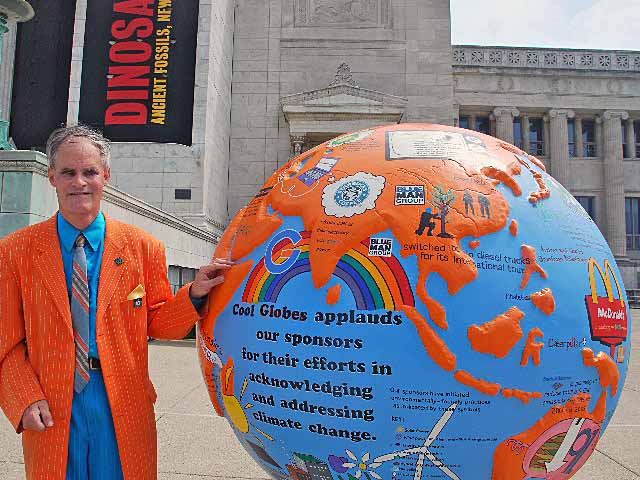
Well, Fashion Man will be on the silver screen in Chicago, starting tonight at the Gene Siskel Film Center. He's the subject of a new film, "Vincent: A Life in Color." I was alerted to this by a piece in yesterday's Tribune, but the film has already made an impact at numerous film festivals outside of the Chicago area.
Turns out that Vincent Falk, whom I assumed was simply an eccentric dresser with a touch of Asperger's, is legally blind. After eight years in a Chicago orphanage, he found a family. (You can find a tribute to his adoptive mother at the website that Mr. Falk, a retired computer programmer, maintains.)
Though legally blind, Falk can still recognize a pretty girl: I overheard him introducing himself to a young lady in the vestibule at St. Peter's (though I thought his name was "Justin," which didn't seem to fit his age--in fact, he's a young-looking 60). I find it very interesting, intriguing, really, that a legally blind person would have a hobby in photography, but Falk apparently does, if his website is any guide. Some of those photos were done with the timer setting on a Nikon D-80, which is a pretty fine DSLR.
I'll be looking forward to seeing the film and learning more about one of our city's beloved characters.
Are there any local characters in your area who ought to be on the silver screen?
Thursday, May 06, 2010
Sr Helena on the Air!
Sister Helena was interviewed this morning about the documentary film she is writing (see trailer in my sidebar); listen in! (This is for Windows; if you're a Mac, download the file from the link.)
Summer Reading
I got a package from the motherhouse the other day. Inside were six copies of a new children's book. It's part of a series that we are publishing for school book fairs. I got the copies because this newest book (Family Ties) includes one (1) story I wrote years ago for My Friend Magazine, under the name "Deborah Boudreau." (The editorial department had a heck of a time tracking down Ms. Boudreau when they wanted to use her story; seems they couldn't find any correspondence with her at all in the files.)
Anyway, the thought came to me that the "Quick Reads" series would be ideal for summer reading for ages 8-10: a story a day to keep the child's reading skills active and engaged. Another book in the series is Friend 2 Friend. Between the two titles, there are 24 days of summer filled with reading!
And if you find Deborah Boudreau's story, be sure to leave a comment...
Anyway, the thought came to me that the "Quick Reads" series would be ideal for summer reading for ages 8-10: a story a day to keep the child's reading skills active and engaged. Another book in the series is Friend 2 Friend. Between the two titles, there are 24 days of summer filled with reading!
And if you find Deborah Boudreau's story, be sure to leave a comment...
Wednesday, May 05, 2010
Fatima and the new secret message
So Pope Benedict will be going to Portugal next week, paying his respects in a special way to Our Lady at Fatima. According to the Vatican spokesman, Fr. Lombardi, the Pope will deliver an "intense" message while there.
What's the message about?
Guess that's the "Secret of Fatima" until next week!
What's the message about?
Guess that's the "Secret of Fatima" until next week!
The Return of Screwtape

 This sounds great! A more contemporary take on the Screwtape Letters (fabulous!); this time, instead of Screwtape and Wormwood, it's A. F. Christian ("a former" Christian) writing to the prolifically publishing new atheists of our time.
Speaking of Screwtape, it looks like the stage version of Screwtape is playing in New York; will it return to Chicago and points west? We saw it about two years ago: fabulous. (On the Facebook page, you can enter a contest to win tickets to the performances in NYC.)
The review linked above is by one of Fr. Barron's associates at Word on Fire Catholic Ministries.
Doing St Joseph Proud
Our community, since about its first decade, has dedicated the first Wednesday of every month to St. Joseph. It's a way of remembering the humble virtues of the man who taught God how to work.
And we also have a community tradition of hard work. Once, one of the early members came to Church one day with ink-stained hands--to the horror of a visiting ecclesiastic, who said, "Aren't you ashamed to come here with your hands like that?" The printer just smiled. St. Joseph would have been proud. Those ink stains were like the merit badges of the apostolate.
Well, today I would do St. Joseph proud. We ordered a used HP printer (1220c) to replace a trusty but malfunctioning one (for which we still have a supply of very expensive ink cartridges). I've valued this printer for years because it does really good quality color work and takes up to 13" wide paper, so I can use it for posters (on photo paper, which really makes the images powerful). The printer came today. Ours may have been broken (and, okay, the innards were covered with a fine mist of black ink), but this one was filthy. And missing a part. And out of alignment.
Now it's clean and functioning, but my hands... well, like I said, St. Joseph would be proud of my inky fingertips.
And we also have a community tradition of hard work. Once, one of the early members came to Church one day with ink-stained hands--to the horror of a visiting ecclesiastic, who said, "Aren't you ashamed to come here with your hands like that?" The printer just smiled. St. Joseph would have been proud. Those ink stains were like the merit badges of the apostolate.
Well, today I would do St. Joseph proud. We ordered a used HP printer (1220c) to replace a trusty but malfunctioning one (for which we still have a supply of very expensive ink cartridges). I've valued this printer for years because it does really good quality color work and takes up to 13" wide paper, so I can use it for posters (on photo paper, which really makes the images powerful). The printer came today. Ours may have been broken (and, okay, the innards were covered with a fine mist of black ink), but this one was filthy. And missing a part. And out of alignment.
Now it's clean and functioning, but my hands... well, like I said, St. Joseph would be proud of my inky fingertips.
Monday, May 03, 2010
The Real Church ("Nuns Rock")
Yesterday's opinion piece in the New York Times was rather refreshing. Nicholas Kristof didn't intend, he says, to write about the Catholic Church again, but its members have the unsettling trait of showing up all over the world, carrying out the most varied forms of service--the kind that a writer of human interest stories wants to write about. So there he was in Sudan...
I think Kristof is starting to get it. Identifying the Pope or cardinals or bishops with "the" Church is a little like identifying U2 with Bono. It's valid--but incomplete. Bono is the most recognizable of the group, the one member who can stand for the whole, but Bono≠U2.
In the Church, the Pope represents Christ, and teaches in his name, but the Christ and the Church form one body, and that body has many essential members. Putting too much emphasis on the person of the Pope or the bishop tends to reinforce a clerical mindset: that the Church belongs to the clergy, and the laity are just along for the ride. This gives the clergy more power than is their due, and relieves the laity of their responsibility for bringing the Gospel forward, making it penetrate and transform society.
This is where the nuns come in. We aren't clergy: we are lay women. So we're not part of the hierarchy. We're in the trenches with our specific charisms for the transformation of the world in a way that is different from that of most lay people, and yet definitely not in a hierarchical way. The Church needs both dimensions of life: the "skeleton" of the hierarchy, and the "flesh" of the laity. Remember St. Therese a century and a half ago writing that she would be "love in the heart of the Church"? She was onto something. As Kristof wrote, "Nuns rock." (Lord, make me into that kind of nun!)
I think Kristof is starting to get it. Identifying the Pope or cardinals or bishops with "the" Church is a little like identifying U2 with Bono. It's valid--but incomplete. Bono is the most recognizable of the group, the one member who can stand for the whole, but Bono≠U2.
In the Church, the Pope represents Christ, and teaches in his name, but the Christ and the Church form one body, and that body has many essential members. Putting too much emphasis on the person of the Pope or the bishop tends to reinforce a clerical mindset: that the Church belongs to the clergy, and the laity are just along for the ride. This gives the clergy more power than is their due, and relieves the laity of their responsibility for bringing the Gospel forward, making it penetrate and transform society.
This is where the nuns come in. We aren't clergy: we are lay women. So we're not part of the hierarchy. We're in the trenches with our specific charisms for the transformation of the world in a way that is different from that of most lay people, and yet definitely not in a hierarchical way. The Church needs both dimensions of life: the "skeleton" of the hierarchy, and the "flesh" of the laity. Remember St. Therese a century and a half ago writing that she would be "love in the heart of the Church"? She was onto something. As Kristof wrote, "Nuns rock." (Lord, make me into that kind of nun!)
Live from California....
Our sisters in L.A. must have had fun putting together this unusual inside look at the community.... how many of the sisters do you know?
Saturday, May 01, 2010
Back home!
The morning retreat at the Cathedral of St. Paul went well. I met Judy (hi, Judy!) at the hospitality after Mass, as we enjoyed banana bread and other treats that had been prepared by mothers of St. Paul priests. They take care of the food, and the Archconfraternity of St. Paul sponsors the monthly retreat at the National Shrine of St. Paul. Naturally, as a Daughter of St Paul, I was delighted to be there where even civic buildings and associations have names that sound so welcoming. And the Little Sisters of the Poor were also very welcoming (as was their big fluffy cat). (I am a cat person.)
Of course, actually getting to St Paul turned out to be the most challenging part of the retreat. Things didn't start out to auspiciously: the Orange Line to Midway arrived later than I anticipated, and then it was in slow zones almost the whole way. I made it to the baggage check-in within the 45-minute window, and then on to security. That's where I learned not to trust the "Expert Traveler" sign at Midway. This will lead you to a checkpoint that is all the way down another (invisible) hallway. The "Expert Travelers" ran the risk of missing their flights as they inched forward. I had been thinking about getting a little treat on my way to the gate, but there was no time for treats when I got there: boarding had begun. I found a seat (this was Southwest) and then the fun really began: the bumpiest ride this side of a roller coaster. Or maybe even more so. When we were ready to land at Minneapolis/St. Paul, suddenly we began climbing again. We circled the area for about an hour, rodeo-style, as if the plane were a bucking bronco. You could hear the luggage in the overhead bins slamming forward. I was never so grateful for the invention of seatbelts. The kids behind me (there was a little girl who was calling herself "Princess Sarah") were making the best of it. When we did land (an hour late), applause broke out all over the plane.
As we started to deplane, a young Jewish man a few seats ahead of me (he had been in front of me in the TSA line) turned with a smile. "Did you see the rainbow?" (All I could see was the wing. And dark clouds.) "I guess God decided to keep the covenant." He was referring not simply to the story of Noah, but to the Jewish blessing-prayer that is traditionally offered upon seeing a rainbow: Blessed are you, Eternal our God, Ruler of the universe, Who remembers the covenant, is faithful to the covenant and Who fulfills your Word." That prayer was already written into the notes for my talk! Another "coincidence" happened during the break this morning, I visited the history exhibit in the Cathedral vestibule. A mom was there with two children, one of them a little girl in pink who was, truth to tell, tired of looking at old books. "Sarah, calm down," the mother said. Sarah? "Excuse me, little girl," I said, "but are you the same Sarah who was on a very exciting plane ride yesterday?" She was!
Tomorrow looks like a full day, too: after choir practice and the choir Mass, I have tickets for the Opera "Giasone" by the Chicago Opera Theater. They gave it 4 stars! I hope I do, too!
Of course, actually getting to St Paul turned out to be the most challenging part of the retreat. Things didn't start out to auspiciously: the Orange Line to Midway arrived later than I anticipated, and then it was in slow zones almost the whole way. I made it to the baggage check-in within the 45-minute window, and then on to security. That's where I learned not to trust the "Expert Traveler" sign at Midway. This will lead you to a checkpoint that is all the way down another (invisible) hallway. The "Expert Travelers" ran the risk of missing their flights as they inched forward. I had been thinking about getting a little treat on my way to the gate, but there was no time for treats when I got there: boarding had begun. I found a seat (this was Southwest) and then the fun really began: the bumpiest ride this side of a roller coaster. Or maybe even more so. When we were ready to land at Minneapolis/St. Paul, suddenly we began climbing again. We circled the area for about an hour, rodeo-style, as if the plane were a bucking bronco. You could hear the luggage in the overhead bins slamming forward. I was never so grateful for the invention of seatbelts. The kids behind me (there was a little girl who was calling herself "Princess Sarah") were making the best of it. When we did land (an hour late), applause broke out all over the plane.
As we started to deplane, a young Jewish man a few seats ahead of me (he had been in front of me in the TSA line) turned with a smile. "Did you see the rainbow?" (All I could see was the wing. And dark clouds.) "I guess God decided to keep the covenant." He was referring not simply to the story of Noah, but to the Jewish blessing-prayer that is traditionally offered upon seeing a rainbow: Blessed are you, Eternal our God, Ruler of the universe, Who remembers the covenant, is faithful to the covenant and Who fulfills your Word." That prayer was already written into the notes for my talk! Another "coincidence" happened during the break this morning, I visited the history exhibit in the Cathedral vestibule. A mom was there with two children, one of them a little girl in pink who was, truth to tell, tired of looking at old books. "Sarah, calm down," the mother said. Sarah? "Excuse me, little girl," I said, "but are you the same Sarah who was on a very exciting plane ride yesterday?" She was!
Tomorrow looks like a full day, too: after choir practice and the choir Mass, I have tickets for the Opera "Giasone" by the Chicago Opera Theater. They gave it 4 stars! I hope I do, too!
Subscribe to:
Posts (Atom)