Monday, November 30, 2015

Book Review: Guest post from Laura (age 13)


http://www.amazon.com/gp/product/1936855305/ref=as_li_tl?ie=UTF8&camp=1789&creative=9325&creativeASIN=1936855305&linkCode=as2&tag=bescatboo-20&linkId=KYOZFIK3Z7KEYYM4
Blood of a Stone
by Jeanne Lyet Gassman
Tuscany Press, 2015

Reviewed by Laura, age 13

I received a review copy of this historical fiction (sword and sandals era) but found it too hard to get into. It seemed to me that a younger reader would probably be the best reviewer, so I passed it on to thirteen-year-old Laura, an avid reader, for her impressions.

Some background, first:
The story follows the path of Demetrios, the rejected son of a brutal father who had sold him into slavery—a condition he escapes through violence and, he believes, the power of a stone idol he begins to serve. Finding a partner in the Jew Elazer, Demetrios becomes something of an entrepreneur—and a slave owner himself. Then business matters make him aware of the Rabbi Jesus...

Now it's Laura's turn. This review is an edited transcript of a phone interview:

It was a good book; I liked it. It took me about a week to read it, but I had another book to read for English. It was very interesting, “catching”: it had a good hook to it. The storyline was pretty good, too, but there were two or three times where I found myself getting lost. I had to reread part of it to figure out what was happening.

The ending could have been more satisfying.

There are some things I wish had been done differently. I wish Demetrios and his father had a better relationship. And I wish that Jesus had brought Rufus back from the dead. That felt like a lost opportunity. If it had happened, that probably would have changed how the story continued. But as it was, that part of the story got a bit too heavy for me.

My favorite parts were when Demetrios refused to beat his slave. And how Jesus healed the girl. She was my favorite character. I liked the way she stood up to her father in the first couple of chapters. She was a strong person. 

Even though the book was set in ancient times, I was able to follow along. I also learned some new things about history.

I would recommend this book for ages 13 and up.

Tuesday, November 24, 2015

The Letters: a Great Movie for the Jubilee of Mercy!

A week from Friday a new movie about Bl. Teresa of Calcutta opens in theaters. You will definitely want to give this one your support. Not only is it a fine depiction of the life of a woman whose name is practically synonymous with "charity," it will give you a really fitting start to the Jubilee Year of Mercy just a few days after the film's release.


Filmed on location in India and the UK, "The Letters" takes us back and forth between the early work of Mother Teresa, and the stages of her process for canonization (beginning with a miraculous healing). We see Teresa as a newly vowed sister, and then in the classroom where she runs a tight ship, even though the sight of starving displaced families just beyond the convent walls pulls at her heart, and India itself is in the throes of birth as an independent nation. 

Fast-forward to modern times: the Postulator for Mother Teresa's sainthood cause investigates the miracle, and then visits an elderly priest who has a cache of letters from Mother that reveal the unsuspected depths of spiritual darkness in which the smiling foundress lived. (Presumably the priest is Mother's spiritual director, Father Celest van Exem, but he actually died in Calcutta years before Mother herself did.) It is the retired priest who serves as the film's narrator.

I was glad that the filmmakers did not attempt to depict Mother's interior life, or that mysterious "call within a call" which she experienced as a Sister of Loretto while riding the train on her way to her annual retreat. We, like Teresa's Loretto superior and the local bishop, have to rely on what we hear from her own lips. We can understand the frustration of the superior who, not having received any particular divine communications of her own, could only see Sister Teresa's insistence on going out among the poor as a kind of rebellion; something that could split the order, siphon off potential vocations and alienate high-caste parents whose daughters might feel drawn to working with untouchables.
We see Mother's initial efforts to teach the children of the poor and to care for the dying met with  suspicion and even threats on the part of many Hindu slum-dwellers who assumed that the white woman's offers of help were only a ruse to try to convert them to her religion. Why else would someone enter their neighborhoods?

It's not easy to depict the core of a saintly person's life, that relationship with God that gives rise to
everything else. In "The Letters," this was done through Mother Teresa's firmly and frequently repeated: "It's God's will. Not mine." (This, followed by a quick, sharp nod as if to say, "There, that's settled.")

"It's God's will. Not mine." That is why she left her beloved Loretto community and set out, alone, to do something that no one else was doing (or knew needed to be done).

"It's God's will. Not mine." This is why she sought official recognition of her community as a new religious congregation in the Church, even when prudence alone would have said it simply couldn't be done.

I have a few quibbles with the way matters liturgical were handled in the film, but that's me. (The mistakes didn't really impact the film; they just got my liturgical antennae up.) I also thought Mother should have aged a bit more visibly between the 1950 canonical establishment of the Missionaries of Charity and the 1979 Nobel Peace Prize (too bad they cut all the really good parts of the speech out for the movie!). These are trifles compared to the opportunity to witness the way "God's will--not mine" can be done amid dirt, grit, disappointment and rejection. And to witness, through the blessing of media well made, how mercy can be expressed when we seek "God's will--not mine."

We need more movies like The Letters!

Watch the real Mother Teresa's Nobel Peace Prize speech.

Words from the Middle East

As a follow-up to yesterday's post on the refugee crisis and our discomfort with the whole situation, here is a message to the world from the Maronite Bishop of Damascus who is suffering through this with his people. Notice the specific issues being faced by the Christians. (Original is French; I am not sure who did the translation, which has its issues; maybe Google with editing?):

The Twilight of a Church:  The Exodus of Middle Eastern Christians

Since 2003 (the Iraq war) and especially since 2011 (Arab Spring) the exodus of Christians from the east increases. Some reports give only ten years for the page to turn concerning Christianity in the Middle East. This seems to be a pessimistic view, but observed experience shows an alarming and growing emigration movement.

The subject of daily discussions is how to leave.  Go anywhere and in any way even if it means taking dangerous risks. A family just sent their twelve-year-old son away with a caravan of fugitives. A twelve-year-old child has not returned. Will he later be able to invite his family to join him? Will he find a safe place and a suitable home?

Given the military stalemate, an increasingly distant peace, and to avoid military service in order to escape an absurd war that has lasted too long, young people are the greatest number of those who leave.

What future a Church without young people? It is the fatal end of apostolic Christianity in a Biblical Land to become a hostage of violence and intolerance in the name of a radical faith that neither supports pluralism nor accepts differences.

Envisioning the Future
 
How can the Church of the Middle East envision the future? Several paths are available:

(a) Follow the faithful in the countries of the Diaspora to help them to keep their faith of origin.
(b) Establish alliances between minorities to defend their citizens’ rights against the domination of an ‘intolerant’ Islam.
(c) Seek guarantees of protection from the ruling authorities.
(d) Accept living under the shadow of Islam and continue a life full of difficulties and challenges.

Eastern Christians are facing almost suicidal choices (a, b and c). The remaining choice (d) is quite difficult to assume.

Living in the shadow of Islam requires a return to the early centuries of the Church, which highlights the hidden life of Jesus in Nazareth. This dynamism is favored by the Charter of the Year of Mercy announced by the Francis Pope.  Showing the merciful face of Christ gives vitality to the witness to the Gospel. The social Committee who visit Muslim prisoners in Syria highlights the Good Samaritan at the heart of people in distress. This is a providential way, a challenge that enables the continuation of the Mission and the joy of the Divine Child.


BON NOEL 2015
+Samir NASSAR
Archevêque Maronite de Damas

Monday, November 23, 2015

Terrorist attacks and refugee desperation: What to do?

The refugee crisis in the Middle East and Europe has been building up over the past two and a half
years, reaching a point now where definitive action needs to be taken. But the terrorist attacks in Beirut, Paris, Mali, Nigeria (am I forgetting some of them?) put the requirements of national security foremost in everyone's minds. With little to restrain them in the way of conscience, the Paris terrorists (European citizens, all) carried a fake Syrian passport into the fray, ensuring that the refugees now in Europe would shoulder some of the blame and thus face even greater challenges than they did surviving a sea crossing in dinghies and rafts.
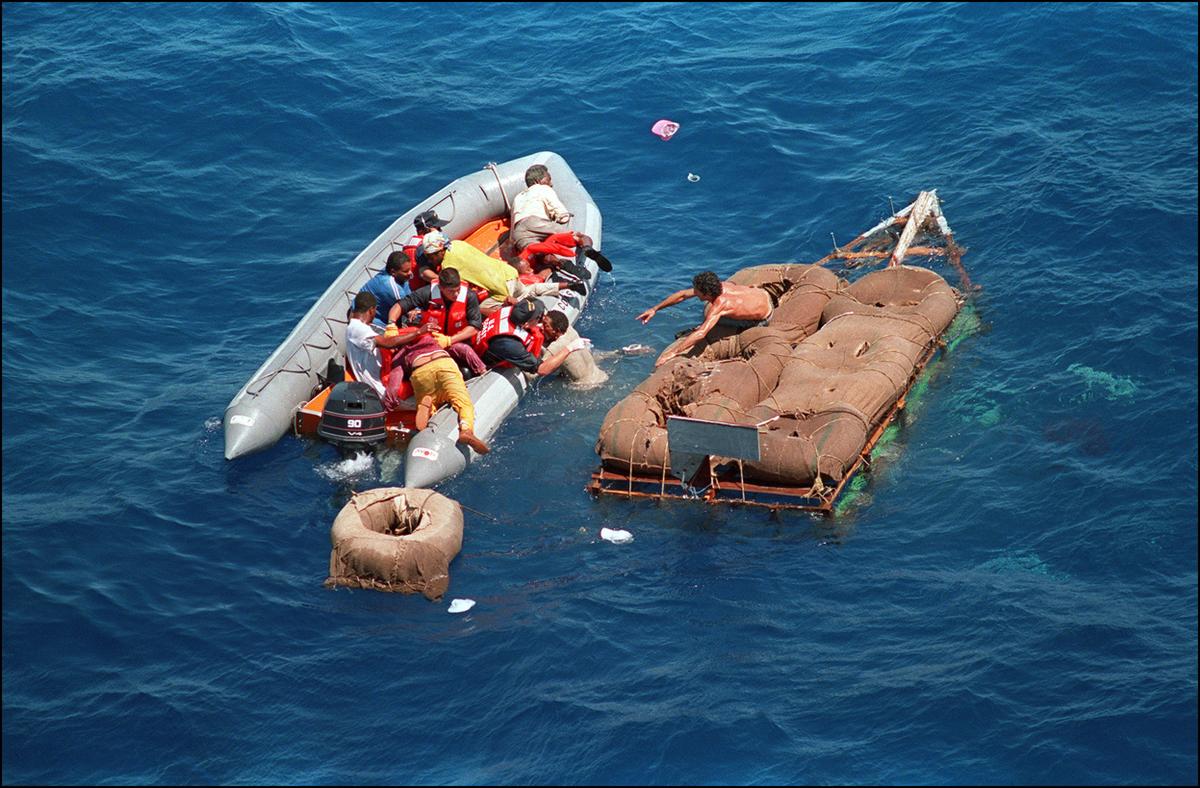
Image of another refugee crisis (from The Atlantic);
the US Coast Guard rescues Cubans from an overturned raft.
Here in the US, we are not getting refugees washed up on our shores (though that did happen in 1994, with refugees from Cuba), but the conversations are nonetheless very heated. Every last refugee, down to the "three year old orphan" is now being seen as a terrorist. Catholic Charities of Baton Rouge, which recently placed two Syrian families in Louisiana, has even been getting phoned-in threats from people who are convinced that we are facing an honest-to-God invasion. There are genuine (and founded) concerns that all those seeking refugee status be properly vetted, and worries about immigrant enclaves forming beachhead communities where our national unity and "way of life" may begin to be undermined through the practice of foreign (i.e. Islamic) law and the force of custom.

I am as confounded as the next person about which steps need to be taken. One step I am sure must not be taken, however, is to accept the judgments of those who portray everything in the starkest terms, especially those who use dehumanizing language that belittles the human dignity of the people whose lives are already in such precarious circumstances. After all, what we across the ocean may fear as a possibility is a reality for tens of thousands of refugees (half of whom, reports indicate are women and children under the age of 17): loss of home, livelihood, family members, security, education. And one thing the fear-mongers neglect to say is that keeping young people in precarious conditions is a sure-fire way of filling their hearts with resentment and preparing them to accept terrorist ideology. In other words, American fear-mongers are doing ISIS' work for them.

Over the past ten or so days, I have found many very informative articles online about the refugee "vetting" process and other issues related to the current events. I am trying to draw on different sources, and not to rely on one or another ideologically-driven news source. It is hard to get solid news about the fate of Christians in the various refugee settings, both in the Middle East and in Europe; there are some indications that the Christians are suffering marginalization and persecution and are avoiding the UN sponsored settlements for refugees. (Unfortunately, this means their numbers are not counted, and their possibility for being considered for refugee status is ruled out.)

Here is some of what I have found (and found helpful):

What's at Stake:
Pope Francis and Paris Archbishop respond to the attacks,
remind that violence in the name of religion is blasphemy.

American Cardinal says ISIS intent on wiping out all Christians in Middle East 

6 Reasons to Welcome Refugees after Paris


Personal Experiences:
Iraqi nun, herself a refugee from the first Gulf war, offers words of insight (including this warning: “While I understand why people would want to react this way out of fear for what they have seen, but by closing our doors to all the victims of ISIS, we are only giving ISIS even more power. In a very real sense, they have succeeded in terrorizing us."

Refugee Resettlement: Balancing Compassion with Discernment: a volunteer with a refugee service offers caution, seeing even long-established refugee families turning bitter as this new crisis unfolds amid harsh rhetoric.

Syrian Christian refugee in Jordan gets help at a Catholic hospital while hoping (against hope?) to be united with his daughter in California.

Syrian Christian dad talks about sending his kids to school in the morning, not knowing if they will survive the day


Information about Refugee processes:
Immigration lawyer explains the refugee process
Corrects some common misunderstandings (and "outright lies").
Three important facts about the US process


Guidance from the Bishops:
President of US Bishops' Conference statement (September)

Statement from Cardinal O'Malley (Boston) on openness to refugees after the Paris attacks

Bishop Malone (Buffalo) offers some advice and a wonderful prayer: why not make that prayer part of your Advent practice?

 
Catholic aid organizations actively addressing the crisis in Syria and other nations in the Middle East:
Franciscan Custody of the Holy Land 
Sovereign Order of Malta
Catholic Near East Welfare Association

Tuesday, November 17, 2015

...especially those in most need of Thy mercy. (UPDATED)

The liturgical year is coming to its conclusion (that's right: Advent is less than two weeks away!), and so the readings at Mass tend to be a little apocalyptic. This year in daily Mass the first reading is from the Second Book of Maccabees (one of the ancient Jewish writings that does not appear in a typical Protestant bible). Tomorrow is my turn to read the story of the heroic mother who saw her seven sons put to death by torture, one after the other, for refusing to make a perfunctory act of idol worship. Every other year, instead of reading from Maccabees or Daniel (that's next week), the readings are from the Book of Revelation. You know, the Apocalypse.

So yesterday during my Hour of Adoration I read the first part of the Book of Revelation. The vicious dragon and his minions; the horsemen of war and plague and famine; the Beast coming up from the sea...  In the light of the newspaper headlines, this mystifying book seemed less symbolic and more realistic than ever before. No wonder it was considered a book of consolation for the (then as now) struggling Christian communities in the Middle East! John the visionary takes us back and forth between the unceasing praise and peace surrounding the throne and the violence still playing out on the earth. The saints and angels already participate in the victory of the Lamb, already won, already in effect: and so do we, especially at Mass (which is its own kind of apocalypse, or "unveiling," of that present but hidden reality: pay attention to the prayer that leads into our "Holy! Holy! Holy!"--a prayer that comes to us in part from the Book of Revelation).

"Introduce a little anarchy. Upset the established order,
and everything becomes chaos."
Back in March, The Atlantic published a very insightful article entitled "What ISIS Really Wants."  I'm not a movie person, but I pay attention to reviews and suchlike. And it didn't take much effort for me to find the movie quote that matches the basic plan of the terrorists we are facing. In short, they want to provoke the Apocalypse and the Second Coming of Christ (which, bizarrely, they believe in).

Technically, we Christians should be doing all we can to not "provoke" but "invoke" the Second Coming. We pray for it three times a day in the liturgy: "Thy Kingdom come!" We'll insistently beg for it during the fast-approaching season of Advent: "Maranatha! Come, Lord Jesus!"

It struck me this morning, praying my Rosary in the brisk (okay, really cold) autumn air. I usually add the Fatima prayer between decades: "O my Jesus, forgive us our sins; save us from the fires of hell; lead all souls to Heaven, especially those in most need of Thy mercy." You don't need to be too theologically subtle to suspect that about now "those in most need" of that Divine Mercy are the bloodthirsty ideologues who delight in sowing chaos where it is least expected to erupt. May the Lord grant us the grace to actually pray for them.


- - - - - - - -


In addition to the Atlantic piece, here are a couple of other insightful articles. I can't say I agree with every word (I don't really know enough about Islam or world history to begin to weigh in), but they offer some perspectives that are often missing in the mainstream media:


Tuesday, November 10, 2015

Sister Beatrice, our Visitor from Zambia

We have had a lovely week-long visit from our Sister Beatrice, a Kenyan Daughter of St Paul currently stationed in Zambia. She was able to come to the US for a conference (the best kind: all expenses paid!); the funders threw in an extra stop anywhere in the States, and she asked to visit our Boston community. I've enjoyed hearing about her assignment in Zambia (nine years, so far), where there are currently four sisters in the community serving a country of 12 million souls. Two other sisters associated to that same small community actually serve in Malawi where we are not yet officially established (and where the sisters' bookstore is a shipping container).

It has been fun hearing Sister's reactions to the US and the ways we do things here. "It truly is like another planet, another world! I like the houses; they are very homely. But there is so much concrete everywhere!" We are well past the peak of an admittedly incredible New England autumn, but there are enough golds and burnished reds left to have inspired quite a few photos! "I had seen pictures of trees like that, but assumed they were painted. I didn't realize those colors were real!"

Sister also participated in the Mass for the profession of vows of our brothers in the Institute of Jesus the Priest (see yesterday's post). The event was held at a retreat house in a woodsy patchwork of towns just outside of posh Wellesely. Naturally, we used GPS to find our way. That brought another amused observation. "Here you never see people walking from place to place." ("That's true," I said, "people only walk for exercise.") "In Africa, there are always people along the road. If you need to know how to get somewhere, you just wave to someone and ask for the next step toward your destination. But here, there is not even a person to ask!" Sister knows whereof she speaks; in Zambia, the sisters are constantly on the road bringing their boxes of books to school and parish book fairs. They always get where they are going; all they have to do is ask.

Sister Beatrice revealed that she had first planned to enter the Comboni sisters, and was working with their vocation directress to see where her talents would fit in with their ministries (primarily healthcare and education). The would-be sister said that she really desired to work in the area of journalism.  "Then you need to meet the Daughters of St Paul." The rest was history. She made her first vows in 1997 and prepared for final vows in Rome with our Sister Tracey, making perpetual profession in 2003. It has been non-stop ever since, but it won't be non-stop on her travels back to Africa...

This afternoon begins the twenty-hour trip home. Please pray for safety for Sister Beatrice and her fellow-travelers, and for blessings on our mission in Zambia and Malawi.

Monday, November 09, 2015

Webathon Update


Well, like Moses who could look upon the Promised Land, but not enter it, we didn't quite get to the Promised Land in our fundraising Webathon Novena, but we got more than halfway there--and we "met" many wonderful and generous people along the way, people who entrusted us with their dearest intentions. Truly, the prayer intentions that were sent to us by Webathon participants were very moving, and will stay in our thoughts and prayers for quite some time: loved ones in need; deceased parents and relatives (in one case, a brother who had died only a week earlier); children in trouble; job seekers...

This morning we began a novena of Masses for all those intentions, as well as the needs and intentions of all our benefactors. They can also count on the promise of Blessed James, who committed himself to spending his eternity not showering down roses like Therese, but supporting those who collaborate with or carry out media evangelization!

Historic Vow Day for the Paulines (but not for the sisters)

Yesterday was a big day for the Pauline Family: Vow Day! Five of our Pauline brothers (from the Society of St Paul) drove up from New York to be here in the Boston area, but it was not to celebrate the vows of any of the sisters here, nor were any of them making vows. The Sister Disciples of the Divine Master joined in, but no new Sisters were to join their ranks. Women from the Pauline Institute of Our Lady of the Annunciation came to the "Betania II" retreat house, but there were no "Annunciationists" making vows yesterday. A married couple from the Pauline Holy Family Institute also came, but not to welcome new vowed members to their institute, either.


So just who were these vow-making Paulines, if not members of any of those Pauline institutes? In an historic event for the Pauline Family,  yesterday the first two American priests of the Institute of Jesus the Priest (founded by Blessed James Alberione) made vows: the first American member, Father Michael Harrington, made his perpetual vows, and another Boston priest, Father Ed Riley, made his first vows. Yes, as priests they already made the promise of celibacy, and a promise of obedience to their bishop. Yesterday they strengthened that commitment to the level of a vow, a solemn oath to God, an act of worship. Plus they added the vow of poverty (not a requirement for diocesan priests, who are encouraged, but not obligated, to live simply--granted that since priests are among the lowest-paid* of all professional workers, that doesn't take a lot of imagination).

Sister Marie Paul congratulates Father Riley, IGS, a long-time
collaborator in our mission (since his pre-seminary days!).
The Institute of Jesus the Priest is a Pauline "secular institute" for diocesan priests. They do not cease being diocesan priests under their bishop's authority and at the service of the needs of the diocese. They do, however, take on a special Pauline "color" in their spirituality, following the guidance of Blessed James' exhortations to let it be Jesus who more and more lives and acts in them, so that even their most personal faculties of mind and will and heart become extensions of Christ's own mind, will and heart. Members also make the effort to carry out or at least facilitate media evangelization, so that the amazing technological gifts society enjoys so much can be used with wisdom.

So rejoice with the worldwide Pauline Family as it expands in our country--and pray that the two congregations (Sisters of Jesus the Good Shepherd and Sisters of Mary, Queen of Apostles) which do not yet have any American members or foundations might soon be established here as well, for the glory of God and the good of souls!


*Average yearly salary for a Catholic priest in 2010 was $30,940 before taxes. (Good thing housing is usually provided!)

Tuesday, November 03, 2015

In the middle of a webathon novena (we need your help!)

We're doing our autumn online fundraiser this week, in the form of a webathon novena for media. Each day we are offering a prayer for a different aspect of media or media evangelization and introduce the area of our own ministry that relates to that form of media (for example, today we focus on the medium of photography). The prayer can be downloaded as a pdf so you can share it with friends you know in that field, or post it on a bulletin board.

The particular "focus" (if you'll forgive the photography pun) of the fundraiser is to renovate a building we call the "Promised Land" (seriously: it's even in the documentation we give the fire department and insurance company). When I entered the Daughters of St Paul, the Promised Land didn't have a name; it was just the stockroom with rows and rows of high shelves neatly stacked with books. I was assigned to the order department, so to this day I could tell you which aisle to go to for encyclicals and where the children's books and catechetical resources could be found. About 20 years
Sweater, scarf and gloves: Sister Mary Joseph is ready to work!
ago, we moved the books to a new warehouse space, put up a few walls and divided the area with cubicles to give the sisters who worked in graphic design a bit more elbow room. That is when the area got named the "Promised Land." I suppose that the intention was to complete the work in a proper manner bit by bit (providing things like heating), but it never happened. The sisters just learned to make do. For twenty years.

In her eighties (believe it or not), Sister Mary
Agnes is one of our rosary-makers.
Our senior sisters, too, have been "making do" with a workshop space where they spend several hours each day making rosaries and missal ribbons or putting CDs in their cases (no, it's not done by machine!). We're hoping to expand their room, but that depends on the outcome of the fundraiser. (So far we are at 19% of the $40,000 goal.)

So now we are sharing the sisters' work and their prayers, and hoping to find people who are able to share with us in a way that will allow the Promised Land to finally be equipped for human habitation. If you can contribute, we will all be most grateful. (Plus, you will be included in the Novena of Remembrance, nine days of Masses
offered for our benefactors and their deceased loved ones.) There are some thank-you gifts of a more material nature, as well, including a small-size replica of Pope Francis' pectoral cross (blessed by the Holy Father when our superior went to Rome in June).

It may not be possible for you to contribute financially toward our goal, but you can surely join us in the daily media prayer (some written by our Founder, others by our sisters in the specific field) and you can probably share our posts on social media. (For starters, go to the Daughters of St Paul Choir page on Facebook and share one of the webathon posts there.)


Here are some of the earlier days of the webathon, along with their prayers. Feel free to share these links, too!
Heading for the Promised Land (day 1)
Called to be Saints and Apostles (All of Us!) (day 2)
The Artist without a Studio (day 3)


Monday, November 02, 2015

Purgatory, in other words

I have a lot of friends on Facebook whom I've never really met up close, but only know through posts and the occasional Instant Message. A while back I got one of those messages from a Coptic Christian in Egypt, asking prayers for his Dad, who had recently died. I wrote back asking him to also pray for my beloved Dad, who left this life ten years ago (his anniversary is next week).

My Coptic friend wrote back with Coptic consolation: "All Our Beloved People are in the Waiting Beloved Comfortable Place with God and Our Mother Virgin Mary and all Angels and Saints...
a Monk told me that today .....about my father."

The Copts put an interesting spin on what we practical Westerners call by its immediate function (purgation, purification). That antechamber to Paradise, where our loved ones still need and benefit from prayers, is the "Waiting Beloved Comfortable Place" where the deceased are not far from God at all. Sounds a bit like St Angela of Foligno, who insisted that the Poor Souls wouldn't change places with us no matter what they were offered: They love God ardently (ardens means burning!) and are drawn to him like moths to a flame. True, for now the flame appears to burn away what is still ungodly in them: all the better! They become more like God in the process, more "capax Dei" (capable of receiving God). They love their spot in the antechamber, because it is the guarantee of possessing God as he is. 

And that makes Purgatory a "Waiting Beloved Comfortable Place."