Showing posts with label pope of rome. Show all posts

Wednesday, February 27, 2013

7 Things Every Catholic Should Know about the Papacy (#5)

The Papacy could have taken a different form—and it still can.

The papacy is the world's oldest continuously existing office. But that doesn't mean it always looked the way it does today. The papacy as we know it took almost 2000 years to take this shape, and it can continue to change according to the needs of the Church.

The experience of the first bishops of Rome was hardly what we could call “pontifical.” Waves of persecution, sometimes lackadaisical, sometimes ferocious, ensured that the local bishop kept a fairly low profile in civil society. Besides, the local bishop probably only had a low social profile: Callistus II (+222), for example, had been a slave.

Things changed dramatically when Constantine legalized Christianity—and then started constructing shrines over the tombs of Peter and Paul. The first church buildings began to appear on the sites of the homes that had hosted the community. Many of these churches are known to this day by the names of the homeowners: Cecilia, Chrysogono, Susanna, Praxedes, Pudentiana...) (You can find a list of the churches by family name and current name here: http://romanchurches.wikia.com/wiki/Titulus.) With the Church taking its place in society, leadership styles also evolved. Popes no longer expected martyrdom to end their ministry. Little by little, imperial trappings became associated with the Bishop of Rome. Even the Roman “basilica” (royal) style of architecture was used for Churches.

 Gregory the Great, by Jacopo Vignali
from the Walters Art Museum
At about the same time, though, Imperial Rome moved east, to the newly named “Constantinople” (Constantine's city), the “new Rome.” Old Rome was left more or less to fend for itself, and the Bishop of Rome stepped into the void. Leo the Great is credited with convincing Attila the Hun to spare the decrepit city; a century later, Gregory (also “the Great”), a monk with diplomatic experience, used his organizational skills (he had been Prefect of Rome) for the relief of the needy, setting up an administrative system to streamline assistance. In effect, Gregory restored government to the city. Now he was not just the Bishop of Rome, he was the de facto mayor. Temporal rule was added to the evangelical tasks of "feed My lambs, feed My sheep."

By Gregory's time, the Church also had land holdings (the farms that produced the goods Gregory's system distributed). These farms, supplemented 3 centuries later with a dubious land grant attributed to Constantine, became the nucleus of the later “Papal States.” Its last remnant is Vatican City.

It was Gregory who sent missionaries to England, extending the immediate authority of the Bishop of Rome to the far-off British Isles. Later missionaries from England took the Gospel to the still-pagan parts of northern Europe, seeking authorization (as well as bishops) from Rome, uniting all the Christians of Europe even more clearly in communion with the Pope, and giving the Bishop of Rome more of a direct hand in the life of the churches in those lands.

Quick to notice the benefits offered by a united Christendom, Charlemagne imposed the Papal liturgy on his lands. (Given the slow work of copying such complicated manuscripts, this was not entirely successful!) Centuries later, St Francis of Assisi did something similar, telling his friars (in 1223) that their liturgies should follow the rites of Rome and not of the various locations they found themselves in. Both Charlemagne and Francis grasped the unifying quality of the Pope's role. So the papal liturgies had, at least on paper, pride of place even in lands with their own ancient rites. Not until the Council of Trent would the liturgical rites of Rome be mandated throughout the Latin Church, unless a locale could prove that its own rites were over 200 years old. (Conveniently, by the time of Trent the printing press assured ample copies could be made available.) 

Naturally, commercial interests also sought to work this unifying power to their own advantage. With the election of the Bishop of Rome in the hands of the priests and people of the city, influential families (with connections throughout Europe) sought to bend the outcome. Even legislation limiting votes to “Cardinal-Bishops” did not free the papacy from being manipulated and even controlled by the powerful, whether kings or clans (see “Bad Popes”). Like it or not, the Pope was now a prince in his own right. He even started having a coronation--with a unique triple tiara style headdress that continued to be used for about 800 years—until Pope Paul VI retired his immediately after the ceremony.

With the series of revolutions in Europe (beginning with France) that ushered in the modern political framework came the overturning of the former relations between secular and religious authority. Where before a ruler might have submitted nominations for bishop, now that was either outlawed by the nation, or simply unthinkable (a Freethinker—relativist—might be nominated!). The Pope began directly appointing more and more bishops.

It was the loss of the Papal States in 1870 (with the birth of the modern nation of Italy)—along with the birth of popular media—that, oddly enough, contributed greatly to the high profile model of papacy we are familiar with today. Early on, Blessed Pope Pius IX protested by declaring himself a “prisoner of the Vatican.” (He had actually lost his residence, the Quirinale, to the new Italian nation.) But there were advantages to being limited to the tiny territory of Vatican City. The pope was now free to focus on his pastoral ministry without being entrenched in local politics.

Commemorative coins issued by the Vatican on the occasion
of Pope Paul's speech before the U.N. General Assembly.
Pope Leo XIII realized that he could address “the Condition of the Working Classes” with the first-ever social encyclical. Pius X reversed his predecessors' course and gave Italian Catholics permission to participate in elections. John XXIII decided to be “prisoner of the Vatican” no more and ventured out to Rome's hospitals and parishes and prisons. And without any input whatsoever, he called a Council when it wasn't all that apparent to most minds in Rome that one was called for. Paul VI became the first “world” Pope, traveling not only out of Italy, but crossing oceans to speak to the United Nations, visiting the Holy Land, India and even Western Samoa (where he met one of the talking chiefs: my local superior's dad!). The papacy had developed in more ways than could have been imagined in the 2nd or 8th century.

And it can continue to develop. Pope John Paul II's encyclical on Christian unity asked for input on how the papal ministry could evolve to better serve the needs of the whole Christian community. Pope Benedict XVI published books as a private theologian under his given name and is resigning the papal office itself—under no exterior pressure at all.

We haven't seen the end of the development of the papacy.  

This is the 5th in a series of 7 Things Every Catholic Should Know about the Papacy

Wednesday, February 20, 2013

7 Things Every Catholic Should Know about the Papacy (#3)

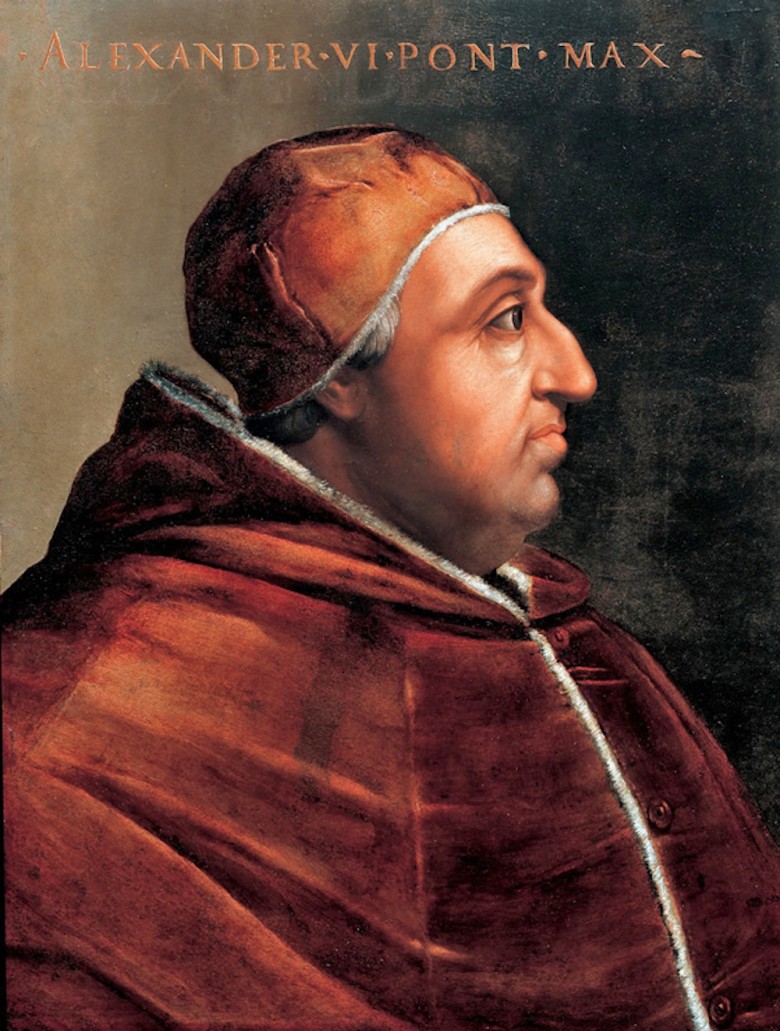
Alexander VI, Poster Child of Bad Popes
Bad popes, good popes, mediocre popes: we've seen them all. And kind of shrugged off most of them as just not that interesting. But the fascination continues with the more notorious occupants of the Chair of Peter. That TV series on the Borgias didn't help, given that one of their own is generally acknowledged as the worst of the bunch.

Popes are men of their times... and the bad popes tell us something about the Church's ever-changing relationship to society. In the early middle ages, influential Roman families controlled the election of the Pope (unless a northern king from, say, Germany, came down and put his own candidate on Peter's Chair). Meanwhile the Vikings were devastating the monasteries that could have been training grounds for scholarly and virtuous bishops (and, possibly, popes). The lack of leadership from within opened the way to exploitation by the powerful, and this continued off and on through the Renaissance. (A series of popes, including the most notorious, came from just two Italian families, the Medici and the Borgia.) The Church became a career path like any other; the Pope a “prince” like any other with lands to defend and commerce to be conducted. Yet despite the financial and moral corruption of some of the successors of St. Peter, none of them ever promulgated false teachings or attempted to rewrite the moral laws they themselves flouted in their personal lives! 

In one of the most challenging eras in Church history, with European leaders in ever-changing alliances and wars (and body counts to match), with Martin Luther's righteous challenges as yet unanswered, two of the less admirable popes succeeded one another. Clement VII (a Medici) was more interested in continental politics than in the city of Rome, which was sacked on his watch. His successor was Paul III, born Alexander Farnese. Through his sister, Farnese had ties to the most infamous of Renaissance popes, the Borgia Alexander VI (the married Julia was the pope's mistress). Farnese himself was a family man who appointed two teenaged grandsons as Cardinals (he had separated from his own mistress, the mother of his four children, before he was ordained to the priesthood--and, to be fair, was not a wicked man).

The young St. Ignatius Loyola
discovering the call of Christ.
Any other institution would have been completely run to the ground, but the Holy Spirit not only has protected the Church from error and from the depredations of her own unworthy leaders, God has been continually raising up SAINTS, the real powerhouses in the Church, to point out the path of the Gospel: “Do not conform to this age, but be transformed by the renewal of your mind!” (Rom. 12:4).

During this same period, some of the greatest saints in history made their mark: Francis Xavier, Teresa of Avila, Ignatius of Loyola, Peter Favre, Philip Neri, John of the Cross, Cajetan, Thomas More, John Fisher, Peter of Alcantera, Francis Borgia (great-grandson of Pope Alexander). Could it be that the weaker and more worldly the Pope, the greater the saints of the age?

Most of the 8-10 generally recognized "bad popes" reigned between 880-1550. As Protestantism made the pope irrelevant to swaths of northern Europe and nation-states began to arise, the climate that had allowed for bad popes gradually changed. We haven't seen their like since.

When a pope is saintly, it could be believed that he – and he alone – is responsible for the spread of the Gospel. But no one can be tempted to shift all the responsibility for the cause of the Gospel on men who are obviously unfaithful to it! Then it becomes clear that the work of evangelization truly rests on the shoulders of each and every member of the Church. (Could the bad popes have been somehow good for the Church, after all?)


This is the third in a series of 7 Things Every Catholic Should Know about the Papacy.
#2 is The Bishop of Rome is the Pope, Not Vice-Versa
#1 is It Was Jesus' Idea to Build His Church on Peter

Tuesday, February 12, 2013

7 Things Every Catholic Should Know about the Papacy (#1)


1. It was Jesus' idea to give his Church structural unity by “building” it on a rock, like a wise man (Mt. 7:24). That “rock” was the former fisherman, Simon, the son of John.

Peter with his keys and his upside-down cross,
from Montserrat, Spain.
Jesus prepared Simon for this role through experiences, teachings (Mt. 17:25), prayers (Lk. 22: 32) and even rebukes (Mt. 16:23) that were unique among the apostles. Then, in a solemn way, he made it explicit by conferring on him a new name, the way God had changed Abram's name to Abraham, and Jacob's name to Israel. But “Peter” was a completely made-up name, invented by Jesus. “You are Peter and on this rock I will build my Church and the gates of hell shall not prevail against it” (Mt 16: 18). Of course, Jesus called him Kephas (Aramaic for “foundation stone” or “rock”) and not the Greek-style “Peter,” but Simon was known by both for the rest of his life. (We see Paul refer to him in both ways—Kephas and Peter—within a few verses in the letter to the Galatians, chapter 2.)

The Gospel of Matthew goes into detail on what this name change meant, quoting the prophet Isaiah to demonstrate the kind of authority Jesus was giving Peter. Like the new “master of the palace,” Peter was given the Master's own set of keys, to open and close, bind and loose. Later (Mt. 18:8) the Apostles would be given that power to bind and loose, but only Peter ever held the keys himself. Peter is consistently singled out among the Twelve. When Jesus offers a challenging teaching, it is Peter who responds for the rest (Mk. 10:28). Even when predicting Simon's betrayals, Jesus affirms his special calling to “strengthen your brothers” (see Lk. 22:32).

On Easter morning, the Angel at the tomb told Mary Magdalen and the other women, “Go tell the disciples and Peter, 'He is going ahead of you into Galilee' “ (Mk. 16:7) She ran “to Simon Peter and the other disciple, the one Jesus loved” (Jn. 20:1). And even though the younger disciple outran Peter, it was Peter who first stepped into the empty tomb while the other waited outside. At the Sea of Galilee, the Risen Jesus put the care of his sheep and lambs into Peter's hands: “Do you love me? Feed my lambs” (see Jn. 21:15-19).

The primitive Church expressed Peter's special role in various ways. In every list of the names of the Apostles (in the Gospels and in Acts), Peter's name comes first. When the question of what to do about Gentiles seeking Baptism caused great controversy in the Jerusalem community, threatening its peace and unity, it was Peter whose declaration caused the assembly to fall silent (Acts 15: 7-11).

Even Paul had to explain, in detail, a confrontation he had had with Peter in Antioch. Although Paul took issue with Peter's behavior (not his teaching), that episode damaged not Peter's credibility, but Paul's.

Ultimately, the papacy comes from Jesus himself, through Peter.