
“I have prayed for you [Simon] that your own faith may not fail;
and you, when once you have turned back, strengthen your brothers.” (Lk 22:32).
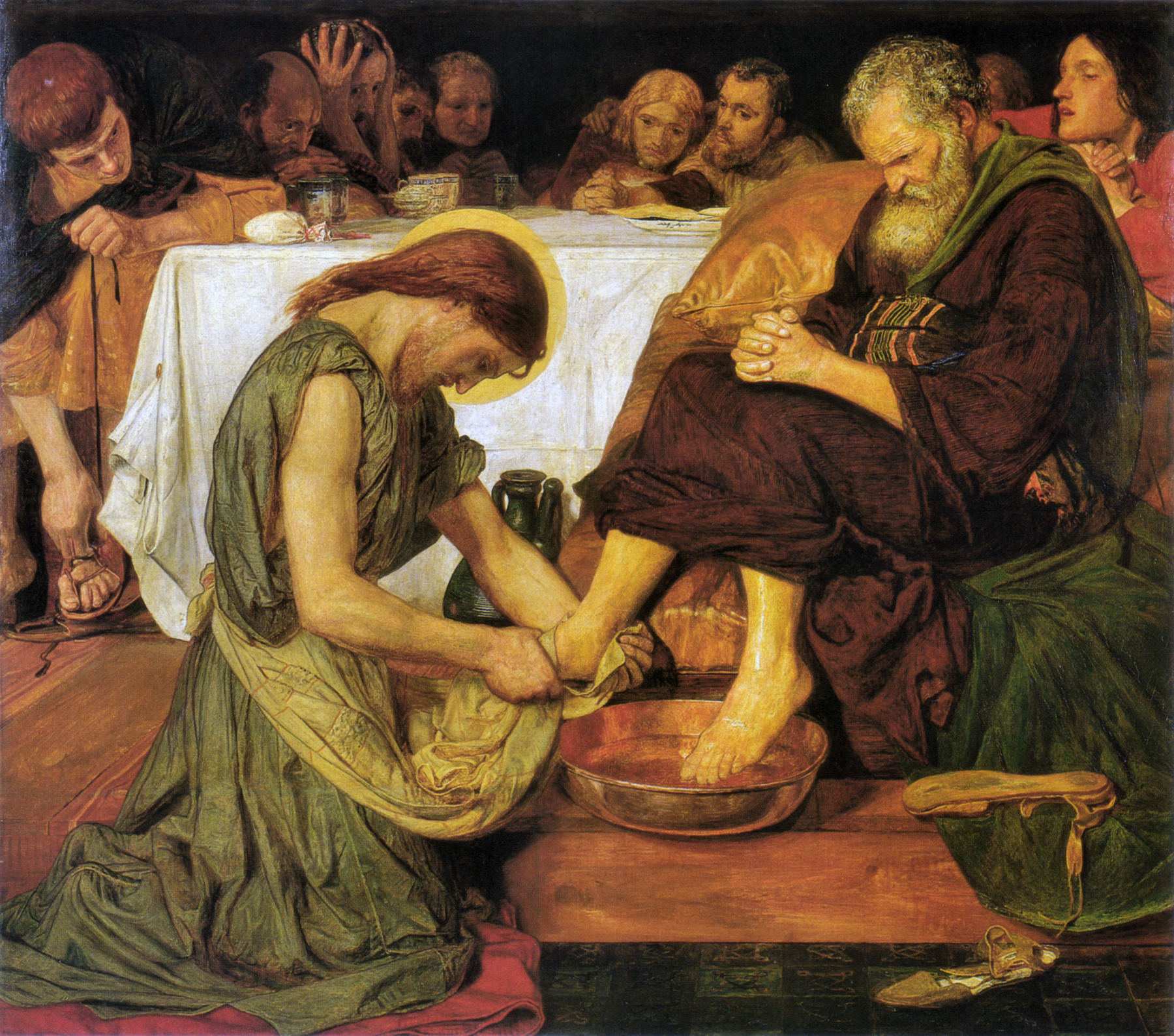
"Modern" artists of the 19th century sought to re-establish the "natural" and "heartfelt" approach that they believed had dominated painting, sculpture and literature before the more staged and self-conscious style of Renaissance artists like Raphael. Eventually, this movement organized itself into the "Pre-Raphaelite Brotherhood." Born in France in 1821 and educated in Belgium and France, Ford Madox Brown visited Italy as a young man and was strongly influenced, by the historic masterpieces there and by the first stirrings of that new movement in art. This is apparent in Brown's 1856 "Christ Washing St. Peter's Feet" (found today in London’s Tate Gallery).
The figure of Christ dominates the foreground as in almost no other artistic rendition of this dramatic moment at the Last Supper. The hem of his garment even seems to flow past the edge of the canvas. Brown shows us a Jesus who is entirely focused on his self-appointed task. His head is bent at an uncomfortable right angle to the chest, perhaps hinting of his bowed head on the cross; his eyes are fixed not on Peter's face, but on his feet. The sleeves of Christ's tunic are pushed up, revealing his muscular arm all the way to the shoulder. The painting seems to impose an atmosphere of profound silence even on the viewer. Certainly, the apostles are struck dumb at seeing "the might of the Lord's arm" employed in such a pointedly servile manner (see Psalm 98:1). If John is peering over Peter's shoulder in thoughtfulness, the other apostles (again, save one) are looking on in horror. Only Judas seems blasé as he bends down over his own feet to loosen his sandal. Peter, on the receiving end of the Lord's quietly deliberate action, looks decidedly ill at ease, but his sandals, with their straps hanging down limply, tell us that he is on holy ground.
At first, Peter's response had been almost the opposite of the Virgin Mary's. She had said, "be it done to me": he had protested, "You shall never wash my feet!" Mary called herself God's slave-girl. Peter, at this point in his life, cannot bring himself to say anything similar. Peter realizes that "If I, the Lord and Master, have washed your feet, then you must wash each other's feet…" And unless he accepts that, he can "have no share"—no communion—with Jesus. He doesn't yet understand, but soon enough he will. And when his own hour comes, he will write to a new generation of disciples, "Christ suffered for you and left you an example, to have you follow in his footsteps" (1 Pet. 2: 21).
This work is in the public domain in the United States; Tate Britain (The Tate Gallery) claims copyright in the United Kingdom on this digital reproduction.


No comments:
Post a Comment