Thursday, January 31, 2008

Pauline Year blog


Last week's feast of the Conversion of St. Paul inspired me to start a rather specialized site for reflections focused on St. Paul and the Pauline Year. This will have a blogroll of Pauline Year links and links to articles on Paul, as well as papers on Paul and Pauline spirituality. I can't put too much into it right now; I just wanted to hang a shingle on a virtual door and stake a claim in view of the project. If you'd like to share some links and so on, please add them to the comments box on this blog!

Pope Benedict's Lenten Message

Here it is, on the theme, "Christ made Himself poor for you" (taken from St. Paul: 2 cor 8:9).

Nightfever in Cologne

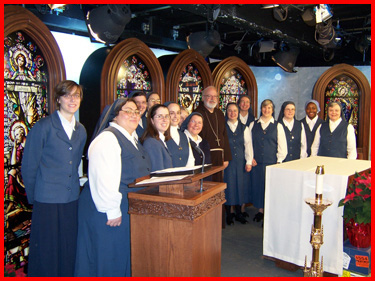
Sr. Ancilla Christine, a Wisconsin farmgirl now in our Düsseldorf, Germany, community, writes about an experience she and the other sisters participate in every month in Cologne. It really is called "Nightfever" because it lasts from 6:00 pm until midnight. Here's the word from Germany:
It begins with Mass and then adoration of the Blessed Sacrament in the sanctuary directly in front of the shrine with the remains of the three kings. A choir sings reflective songs (Taizé, etc.), and young people go out onto the plaza in front of the cathedral inviting the passersby to come in and light a candle: young and old of every faith and tradition. When they people come in they are guided to the place of adoration where they often stay for 10, 15, 30 minutes in a sort of awe-filled prayer. The young people who help run the evening are very love their faith and see it as an opportunity of evangelization. There are also priests hearing confessions during the ... It is unbelievable how many people come and how they are touched by the experience. I always think of Alberione's saying that humanity is like a river flowing.... That's what we witness when we are there.
I'm sure Sr. Christine and the others would appreciate a remembrance in your prayers. As she explains,
"The community here is made up of 5 sisters from 5 different countries"--all of them trying to communicate in German! (Sr. Christine has been in Germany for about three or four years.)

God's Presence

Today's first reading shows us a King David, humbled by God's overwhelmingly generous promises. He "goes in" and "sits down before the Lord" (no doubt, in that tent he had planned to replace with a "house of cedar"). What was in the tent? Materially, not much. The center of attention was the Ark of the Covenant (there is it again!), with its "cherubim throne", a symbol of the abiding presence of God.
David didn't have access to the Eucharistic presence, but we do. It's an inviting presence, welcoming us "in" to "sit down before the Lord," whether our hearts are overwhelmed with grace or sorrow or needs.
Next week, I'm going to be giving a tiny talk, as will Fr. Antoine Thomas, on Eucharistic Adoration for children. This is one of those treasures of the Church that was lost from sight for a generation, but is gradually being rediscovered. I think it is important that it be rediscovered in a healthy way--not simply carried over into the present according to the way it may have been practiced fifty years ago (assuming our reconstruction of the devotions of fifty years ago are accurate!), but rediscovered in a way that brings in all the other rediscovered treasures of the Church, especially the centrality of the Word of God. Anyway, that's what the talk is about. It will be at St. Mary of the Angels, starting with 8:00 Mass, Feb. 9. For info: reding@core.com

Wednesday, January 30, 2008

The House of the Lord

Today's first reading is one we hear maybe twice a year: the message Nathan the prophet is to give to David in answer to the king's proposal to build a temple. Hearing it today, I was struck by the charming way God tells David, "I always lived in a tent as I accompanied the people in their journeys." It made it even more powerful to realize that when John wrote in the prologue of the Gospel "The Word was made flesh and pitched his tent among us," that this was to be seen as a continuation of God's tent-dwelling companionship of his people, wherever they go. Emmanuel: God with us.

Tuesday, January 29, 2008

Looking ahead to Lent

Lent starts NEXT WEEK! Are you ready? Our favorite question here in the bookstore community is "What are you reading for Lent?"
We had two employees out today (out of two), so I was on call downstairs. That gave me a bit of time to look at some of the Lenten resources we have on hand, and one book seemed especially helpful, even though the title is rather stiff (as is the font the designer chose for it!).
"Embrace Your Renewal" (by Fr. Harold Buetow) is presented as a "thought a day" but it is really much more.
I think it should be called "User's Guide to Lent" or something like that. It is more a handbook and daily guide than simply a thought a day. For example, it explains the origins of Lent, and goes into the traditional Lenten practices with some detail: what is Lenten fasting? Why do we fast? How do we fast? When do we fast? Why give alms? How to give alms in our contemporary setting? What to pray for? How does prayer of petition fit in? What other forms of prayer are there? What other Lenten practices are there that make sense in the here and now?
And then there is the "thought a day": a good four pages for each day of Lent, drawing from the day's readings, and interspersed with lots of anecdotes. If you take public transit, this is the book for you, especially because it's not such heavy reading that you need to focus all your attention on the page while keeping an ear on subway stations and bus stops.
"Embrace Your Renewal" will take you all the way to Holy Saturday in this rather extraordinarily early Lent. (The last time Lent was this early was 1913.)
So, what are you reading for Lent?

Sunday, January 27, 2008

Book Meme

Karen was right: This is fun!

Book Meme Rules

1. Pick up the nearest book ( of at least 123 pages).
2. Open the book to page 123.
3. Find the fifth sentence.
4. Post the next three sentences.
5. Tag five people.

Just so happens the nearest book to me at the moment is "Paul, Apostle of the Heart Set Free" by F. F. Bruce. It's an old reprint (Eerdmans) that I finished reading a few weeks ago and am keeping handy so I can dictate notes into the computer. (I love voice-recognition software!) So...
The fifth sentence happens to be in the middle of page 123. (This is an exegetical type work with humongously long sentences.)
But it is in Paul that the presentation of Christ as the image of God is worked out most fully and consistently, with its corollary of the increasing transformation of the people of Christ into that same image by the power of the indwelling Spirit, until nothing remains of the earthly image in those who finally display the image of the heavenly man. Man, according to the Old Testament, was made in God's image and for his glory: in the order of creation he is, as Paul says, 'the image and glory of God'. It is difficult to dissociate Paul's portrayal of the risen Christ as the second man, the last Adam, from his view of Christ as the image of God and the revealer of his glory.
That was three sentences. Too bad I had to stop there; the fourth was really good.
Now, to tag five people! Blanca (this should help you get your book blog going!), Sr. Lorraine (and happy feast day to you), Lisa, RAnn (who has been writing about books anyway), and Veritas (even though it's a bit out of your usual focus; maybe you'd rather do it in my comments?).

Cousin Tom

Thomas is a big name in my family. It was my Dad's middle name, and is the middle name of two teenage nephews. I have a brother Thomas (Thomas More; he's a lawyer), an Uncle Tommy and a long-departed Great-Uncle Tom. But only this year did I learn that I have a cousin Thomas. A third cousin, to be exact. Thirty-eight times removed, to be even more specific. That takes me all the way back to...the 13th Century. (Genealogy is an amazing thing.)

Saturday, January 26, 2008

St. Timothy and What's in a Name?

As I woke up this morning, my first thought (other than, "Is it really morning already?") was, "If I had gotten the profession name I wanted, today would be my feast day." Then I recognized that the name I was given in my religious profession (Joan) turned out to have a meaning for me that I didn't even find until 25 years of vowed life later. Here's the story.
When we make our vows, we keep our baptismal name (religious profession builds on the baptismal consecration and expresses it in a more radical way), but we have the option of adding a new name. Used to be (and in some communities it still is that way), a religious would get an entirely new name, with overtones of the former person being "dead to the world", but with the loss of the baptismal connection. Anyway, when I was a novice, Mother Paula loved to choose the new names for the sisters. We were to submit, for her decision, our parents' names, plus one name of our choice, which had to come with a fairly decent explanation of just why that would be a good name for you to assume in making your vows. My parents names are James and Winifred. Well, James was out because another novice's father had been named James, and he had died, so she was going to get the name in his honor. I was told that Mother Paula, whose native dialect sounds almost French, just wrinkled her nose at Mom's name, commenting, "What a name!" (sorry, Mom). Well, my own preference was for the name Timothy. I would be "Sister Anne Timothy." (Has a certain ring to it, don't you think?) My explanation was that with "Anne" I had a connection to Our Lady, by being named for her mother. "Timothy" would be a connection with St. Paul, whose disciple he had been. "What?!" you might say, "A man saint?" The funny thing is, in religious life, your profession saint doesn't have to be of the same sex. (That's why there are so many men saints with "Mary" in their names, even if mostly they are from other cultures: Jean-Marie Vianney; Maximillian Maria Kolbe; Josemaria Escriva... )
Back to my story.
I hadn't realized that Mother Paula was hoping that some novices would ask for the names of
the two sisters who died that spring: Sister Joan Mary and Sister Miriam. Timothy was out; Joan was in. (Sister Susan got Miriam; her mom's name was Madge, and we already had a Sr. Susan John.) Since Sr. Joan Mary had always claimed "St. John the Beloved" as her patron, I followed her practice, and celebrated Dec. 27 as my feast day. (In Italian, which Sr. Joan Mary spoke at home, John and Joan are rendered "Giovanni" and "Giovanna"; it wasn't as much of a stretch as it sounds in English.) Then, around 25 years later, I had an insight about St. John the Baptist that gave me so much light, I had to switch allegiances and claim this John. Even so, I still have a tinge of longing for a name with a few more syllables...

Thursday, January 24, 2008

Conversion of St. Paul


" I was a blasphemer and a persecutor and contemptuous. But I have been treated mercifully, because while I lacked faith I acted in ignorance. But the grace of our Lord filled me with faith and with the love that is in Christ Jesus."


St. Paul never lost sight of his role as a persecutor, but instead of becoming saddened by it, he marveled all the more at the grace and mercy of God.

Conversion, as St. Paul experienced it and expressed it in Galatians 2, meant dying to something that was "holy and just and good" (Romans 7:12), to make room for what was infinitely holier: the "surpassing wealth of knowing Christ Jesus my Lord" (Philippians 3:8).

Here it is!

The theme and message for the World Day of Social Communication (May 4 in most places):
The Media: At the Crossroads between Self-Promotion and Service.
Searching for the Truth in order to Share it with Others

Day of Prayer for Kenya

I received this from a Kenyan friend who hopes to enter the Daughters of St. Paul in her homeland, which is still gravely threatened even though it's not so much in the news right now:

As many of you know, Kenya has been undergoing a time of political unrest since the December 27 presidential elections last year. Many lives have been lost, many displaced, property destroyed, with the situation still unresolved between our leaders. Please join Kenyans throughout the world as we pray for peace and healing for our country.

God says, "If my people who are called by my name will humble themselves and pray, I will hear from heaven, I will hear and I will come and HEAL THEIR LAND." (2 Chronicles 7:14)

On January 25th 2008, we are asking every Kenyan and Friends, everywhere to take time to make a concerted prayer for Kenya.

We want EVERY Kenyan and friend in EVERY CONTINENT on the face of the earth to be praying together on this one day on behalf of our country.


‧ On January 25th, make a point of setting aside time to pray for Kenya, it does not have to be a long time but please effort to pray for specific things about Kenya.


‧ You can pray individually, or get together with a friend or friends, workmates, someone on the street, your priest, pastor, congregation, youth group

What to pray for:
AMANI, AMANI, AMANI (PEACE, PEACE,
PEACE)

Whatever else you feel in your heart to pray for concerning Kenya

'Lord, make me an instrument of your peace; where there is hatred, let me sow love; where there is injury, pardon; where there is doubt, faith; where there is despair, hope; where there is darkness, light; and where there is sadness, joy.'

(St Francis)

Maombi ya mtu mwenye haki yana nguvu na huleta matokeo.' (James 5:16)

(The effective prayer of a righteous man can accomplish much)

THANK YOU AND GOD BLESS YOU ALL!!!


Paulines in Sudan

Our Superior General has accepted the plea of the bishop of Juba in Southern Sudan to "offer the charity of the truth" by helping the local Church in the field of evangelization and promotion of human dignity through communications media. There are eight dioceses in Southern Sudan, plus the diocese of Karthoum in Northern Sudan; overall, Sudan is currently 13.5% Catholic.
Sr. Josette and Sr. Maria Moraa are ready to go, but there are a few things they really need. They already have a tiny, prefab house from the bishop, but after the years of war, it needs some patching--and some furniture! They also need a four-wheel drive vehicle that will be up to bringing them to the more remote regions. And they need books and audiovisuals for every level of age and education, from children to priests.
Organizations and individuals are being invited (consider yourself among them!) to contribute to this new mission.

Donations can be sent to:
Unicredit Banca ag.15
Via della Conciliazione 6,
Roma, Italy

The necessary information is:
C/C 5053238
ABI 2008
CAB 03215
Istituto Pia Societa Figlie di S. Paolo
FOR: Daughters of St. Paul -- Kenya-Sudan

Clearly, Sr. Josette and Sr. Maria hope for your prayers to support them as they enter this challenging mission field, in imitation of St. Paul.

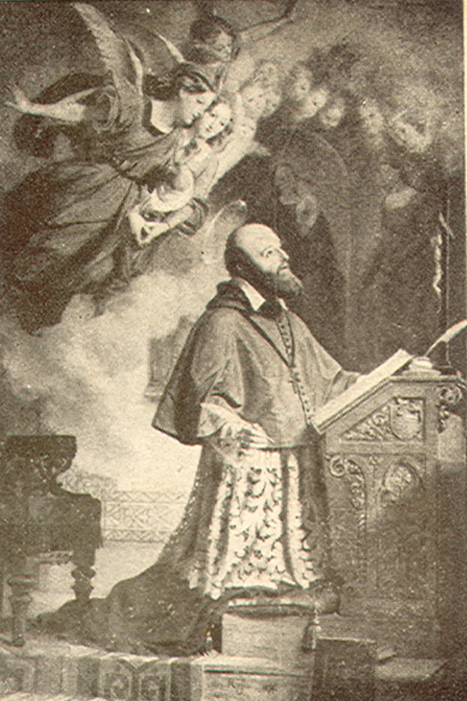
Francis de Sales

Today is the "official" day for the Vatican to announce the theme of the World Day of Social Communication (generally celebrated on the 7th Sunday of Easter). In actuality, they have had to announce the theme months ahead of today's feast of the patron saint of the Catholic press, because the press needs more time than that to do anything with the theme. (Which, in case you were wondering, I cannot find anywhere! I'll let you know later.)
Today's saint, by the way, is the inspirer of the spirituality of the Salesians, founded not by Francis de Sales, but by St. John Bosco. (Called "Don" Bosco, as in "Don Corleone": a title of respect. Got that? Respect.) Francis de Sales was born with a violent temper, but came to be known as the "meekest man after Christ." Even the prayers for the Mass today highlight this characteristic gentleness. He was a spiritual director and author of books on prayer that are still best-sellers ("Introduction to the Devout Life" is one of them). With St. Jane Frances de Chantal, he founded the Visitation Order, which was intended to be an active community, visiting the needy and sick in their homes, but which the church law of the day assigned to the cloister. (Later, Francis is said to have advised another founder, St. Vincent de Paul, not to let the Daughters of Charity pronounce solemn vows, so that they would be free to carry out their apostolate of charity!)
Francis also had the unenviable role of being the Catholic bishop of John Calvin's own stronghold of Geneva, Switzerland, during the latter part of the Reformation. This probably did a lot to hone his temper into gentleness.
Our Founder, too, was influenced by the spiritual writings of St. Francis de Sales, who was one of the patron saints of the diocesan seminary in Alba, Italy: a wonderful and providential "coincidence" that the patron of the Catholic Press would be an inspiration to a future apostle of the Press!

Wednesday, January 23, 2008

Conversion of St. Paul

We're just two days away from the feast of the Conversion of St. Paul, the only conversion in all of history that is celebrated liturgically. I found a great thought from a sermon of St. Bernard regarding the "light from heaven": "We are clearly meant to understand by this that the brightness was around him but not within him. Paul heard the Lord's voice, but he did not see the Lord's face; he was being educated fro faith and, as he himself later taught, faith comes from what is heard."

Tuesday, January 22, 2008

Rejoicing in the Right to Life

When I was stationed on the East Coast, I was able to participate in the huge March for Life about four times. My bones still remember the chill! And today there actually is a lot to be thankful for, as Sr. Lorraine points out.
Today I prayed for all those millions of women who account for the 40 or so million abortions performed in this country since 1973, and for the men in their lives. I prayed for the parents who forced their daughters into abortion clinics rather than be shamed by their untimely pregnancies, and I prayed for young people at risk in a climate of impurity. I prayed for the undocumented immigrant women who are being so horribly vilified by talk-show personalities who pay lip service to the right to life, but can't seem to muster any respect for a pregnant Mexican in one of our cities. I prayed for the woman who, twenty-six years ago, wrote to our publishing house to say that a pro-life pamphlet I had written led her to a change of heart after she had aborted five babies. All those abortions hadn't helped solve her problems. I hope she has been able to find healing, not just over the abortions, but in that deep need of hers that led her down the same dark path over and over again.
Abortion is only one aspect of the whole, great issue of respect for life, but it is a defining one. As Mother Teresa said, if we tolerate this, what boundaries are left?

Monday, January 21, 2008

Fasting for Life

An article in today's Tribune made it abundantly clear why we have been asked by the US Catholic bishops to observe January 22 as a day of penance in reparation for the sins committed against human life. The article focused on a "charity" that provides funds for poor women to have abortions. You see, poor women are the ones who need abortions, but they can't afford them the way middle-class women can. And the poor women need the abortions, because they lack jobs and child care.
Wait a minute. If jobs and child care are what are most needed, why is there an organization that claims to recognize the need focusing instead on funding abortions?
Oh, of course. That's a lot easier than training people for jobs, helping them find reasonable employment, and making sure that children are raised in a secure and loving environment. Makes a lot of sense.
But abortion is only the most heinous example of a sin against human life. I saw in yesterday's headlines that a science lab has successfully created human clones, viable embryos, from people's skin cells. The goal is not to bring the clones to birth, but to eventually develop a type of farming system, so that embryo-clones can provide stem cells and tissues that are genetically identical to a patient's. For the patient's advantage, not the embryo's. The embryo gets to die. Or maybe stay frozen.
So January 22, we are asked to put our own bodies on the line, in fasting and prayer, to implore a much-needed change of mentality in life issues. It's not a matter of giving preference to either/or: "women or babies" ; "embryos or desperately sick patients." All human life that deserves profound respect, the same that we recognize should be given to any person, rich or poor. Social structures and support have to match the respect we claim to have. We need to pray for enlightenment in that regard, too.

Some have (several) hats

The WGA strike has given Karen Hall (of "Some Have Hats) time to reorganize her blogs, retiring one and introducing a new one with the special focus of unabashed support for beleaguered Jesuits. It even has a feature in which beleaguered Jesuits can submit posts which will be under the title, "The Unknown Jesuit." Mostly, though, it's a call to prayer.
We all need that.

Off and running

Debbie, from A Charmed Life, sent in a special request. She will be running her first marathon: a fund raiser for lung cancer research. (Her Mom, who never "smoked so much as a ham her entire life," died of lung cancer two years ago tomorrow.) I have no means of contributing, but perhaps my gentle readers do. Get the details from Debbie on her site or the "Lungevity" site.

mlk

As a child in the deep South during the latter part of the civil rights struggle (not to say it isn't an ongoing thing), I didn't understand much of what was in the news and on TV about Martin Luther King. During family gatherings, the grown-ups gathered in a front room to speak in urgent, low tones about what was going on. One year, we even left for Houston, believing that there would be murderous riots in New Orleans at Mardi Gras. Only later, having met one of Dr. King's collaborators in the Southern Christian Leadership Conference who had become a Catholic at the parish we attended in Virginia, did I begin to grasp how moderate and moderating King's efforts were. When I experience injustice, I don't want to be so moderate! How fitting for Martin Luther King day that the theme for the Week of Prayer for Christian Unity should be "Pray always with justice: 'See that none of you repays evil for evil, but always seek to do good to one another and to all'."

St. Agnes

Today's saint captivated the imagination of the early Church. Agnes is the prototypical virgin martyr, but it is her chastity that is her predominant attribute--at least, it is this aspect of her Christian witness (martyrdom!) that has had the greatest impact on the Church. In fact, much of the symbolism and language used throughout Church history to speak of consecrated chastity draws upon the story of St. Agnes. Even in the Liturgy of the Hours, the common prayers for a virgin saint come from the story of this young martyr.
Her intention to preserve her chastity for the Lord was as much a "witness" as her bloody martyr's death. The stories of her "passio" (suffering) highlight this determination of hers by telling of how she was thrown into a brothel to be the plaything of that discriminating clientele. There was something about her decision for chastity that unsettled the powers of the age, and they were determined to undermine her decision. The stories emphasize the miraculous in order to show that they were unsuccessful in compromising her will.
St. Ambrose commented that Agnes, twelve years old, was not of legal age to testify to anything before the courts of her time, and yet she was capable of testifying to the Lord in a harsh and extended martyrdom. The site of the assault on her purity, at the ancient racetrack now famous as Rome's "Piazza Navone," is the Church of St. Agnes.

Saturday, January 19, 2008

Christian Unity Prayer

Today's theme for the Week of Prayer for Christian Unity is: Pray always, trusting God alone. 'Give thanks in all circumstances' (1 Thess. 5:18).
Adrienne von Speyr commented on St. Paul's exhortation that the Ephesians "render constant thanks," that we are to offer this prayer of thanksgiving without first inspecting the gift to see if measures up to our personal criteria for thanksgiving. God's providence, which "makes all things work together for good," is unfailingly praiseworthy!

Chosen

The first reading and Gospel for today depict men being called by God for a specific role of service. In the first reading, when the prophet Samuel sees the handsome young Saul, God says, "He is the one I have chosen to be the king of my people." So Samuel anoints Saul as he will later, secretly, anoint David. In the Gospel, it is Levi, son of Alphaeus, who hears Jesus' "Come, follow me." The way the Gospel puts it, Jesus "saw Levi, son of Alphaeus, at his customs post." (He was, you will recall, a tax collector.) It's "that look" again. The look that sees a person, knows him through and through, and still "looks with favor." I found myself praying with Psalm 139, "Lord, you have probed me and you know me..."

Friday, January 18, 2008

Christian Unity Week

Today starts the "week of prayer for Christian unity," with the theme "Pray without Ceasing." I have a special intention for this week of prayer. It is for the members of a schismatic group which calls itself the "Reformed Catholic Church." They operate pretty much under the radar, but they are organizing parishes, dioceses and even religious orders, using all the familiar structures, language and rituals. (The unfamiliar part would be the ordination of women, the recognition of same-sex unions as marriage, the acceptance of abortion under certain circumstances; things like that.) They are not "reformers" in the way of the Protestant reformers, who thought they were bringing the Church and its practices back in line with earlier, purer forms. These new, would-be reformers have set up what they think the Church of Christ "ought" to be like. That being the case, it is not surprising that their vision coincides on a remarkable number of points with the spirit of the age. Also unsurprisingly, they made sure that their bishops (so far, all seem to be male) received valid Orders, so that the Catholic Church (the original one) will have to take them seriously.
It would be easy to condemn this group and its adherents out of hand: there is a certain pitiful pride in their press releases and blog posts. The leaders of this movement clearly believe that they are to our age what Francis of Assisi was to his: called to "rebuild the Church."
And to create yet another break within the Body of Christ...isn't that a tip-off that something has gone very wrong?
But I can understand why some people may latch on to something so obviously delusional: people whose marriages or partnerships cannot be recognized by the Church might grasp at the chance to preserve their Catholic identity and a cherished relationship; women who strongly desire the priesthood and do not adequately understand why the Catholic Church cannot ordain them might convince themselves that Orders would be valid in a splinter Church; people who (again, it is so tied in with not understanding the mystery the Church is living in!) think of Catholic life in political, rather than sacramental, terms, and so read everything in a lens of "exclusion" and "inclusion" might well want to preserve the familiar rites while rescripting their context.
In a way, it all comes down to the dread fear of conversion, and none of us are really free of that. Many of us may be free in the particular areas of conversion that the "Reformed Catholic Church" manages to bypass, but none of us relishes the idea of having to face our own resistance to grace and our own blindness when it comes to good and evil.
This week of prayer for Christian Unity, which culminates in the Feast of the Conversion of St. Paul, can be a week of prayer also for openness to the Lord's ongoing gift of conversion and repentance--for all of us.

Birds on the Brain


Sr. Helena noticed an item in yesterday's Tribune that had the two of us off on a mission today: finding the long-eared owls that have chosen a south Loop playground as their winter roost. There were four of them waiting for us (Sr. Helena, I, and several other camera-bearing birders). I had a bit of trouble focusing on them, since they were all nestled in pine trees and my camera kept zeroing in on the needles! (In every photo, the distinctive "ear" tufts came out fuzzy.)

Thursday, January 17, 2008

The Will of God

Our Pauline prayer book has a page in it that we refer to in code language. It is "that" prayer. Say this to a group of Daughters of St. Paul, and we will all know which prayer you are talking about. It is entitled, "Act of Submission to the Will of God."
Maybe it is the language of "submission" that we Americans find so appalling: anything we are asked to "submit" is assumed to be terribly bad, or at least burdensome. And it's not just certain members of my community who think of "submission to the will of God" in that way. How many times do you hear people sigh, with a shrug of the shoulders, "It was the will of God" when they are trying to cope with some tragedy or disappointment?
Interestingly, the "will of God" is a kind of common point between today's first reading and Gospel. In the first reading, the Israelites ask the "will of God" question with regard to their military defeat. But they aren't sincerely seeking the will of God in the matter, as can be seen by their subsequent actions, which attempt to co-opt the power of God, regardless of what his will might be. People only do that when they suspect that the "will" of the other isn't in their favor. The Gospel shows us the opposite disposition: the leper who came to Jesus acknowledged his will and his power: "If you will to do so, you can cure me." That was the leper's "Act of Submission to the Will of God," and it brought him healing.
If only we could change the name of that prayer!

Tales of the Lost Ark

The Ark of the Covenant, so meticulously described in the book of Exodus, has been an object of fascination for centuries, mostly because it was lost. What was it, really? A primitive radio for inter-galactic communication? A secret source of magical power from the earth's minerals? Today's first reading is the story of the first major loss of that mysterious Ark (later, David would retrieve it, and it would be lost again for good in the troubled history of the Kingdom). The Israelites and the Philistines were, as usual, pitted against each other in battle--a battle that the Israelites lost. Scratching their heads over this loss, the elders asked one another, "Why has the Lord permitted us to be defeated today?"
It wasn't really a question, because they didn't seek to discern the answer. All the question did was suggest to them a way to force a solution: "Let us fetch the ark of the Lord from Shiloh that it may go into battle among us and save us from the grasp of our enemies."
The author of the first Book of Samuel comments on this in the next line by simply referring to the "ark of the Lord of hosts, who is enthroned upon the cherubim." In other words, "Foolish elders! They expect the ark itself to save them, and do not look to the transcendent Lord of hosts, whose throne the ark represents!" Even worse, it is the two corrupt sons of Eli who accompany the ark into battle. The ark was captured, and its guardians, Hophni and Phinehas, killed. So much for attempting to force God's hand.
But what about the saints who did similar things in dire circumstances? St. Clare is depicted with a monstrance holding the Eucharist itself, because she carried the Eucharist to the convent window when an invading army was bearing down on Assisi. (The army suddenly turned back.) Our own Mother Paula tucked a medal of St. Paul in the mail box when told that an official letter would be coming from the Archdiocese of New York, ordering the Daughters of St. Paul back to Italy. (The letter never came.) And millions of people, right now, in our own U.S. of A. have statues of St. Joseph buried in the yard of houses they desperately hope to sell.
Are all these guilty of the sin of Hophni and Phinehas? What makes the difference, when the outward actions are so similar to what the Bible condemns?
I think the deciding factor is one of faith: is the action co-natural with the relationship one already has with God, with St. Paul, with St. Joseph? What we are dealing with in the case of St. Clare and Mother Paula (I have reservations about attributing this in a blanket way to the case of all those statues of St. Joseph!), is a kind of sacramental gesture: it is a prayer made concrete. A prayer: not an attempted act of extortion. And a prayer comes with the disposition, "Not my will, but yours be done." Hophni and Phinehas and the elders who sent for the Ark seemed to forget all about that part.

Wednesday, January 16, 2008

Novena to St. Paul


Today begins the novena for the Conversion of St. Paul. Interestingly (in the light of today's first reading), St. Paul spoke of his Damascus experience in the same language the Bible uses for prophetic calls and other special vocations. Scholars like to argue about whether Paul's was a "conversion" or a "vocation" story.


The picture is from St. Paul's Church in Chicago. Interesting how many times Saul is depicted in soldier's armor; it didn't stop Christ from "taking hold" of him!

Vocations and other calls

Today's first reading is the classic vocation story. In fact, in all the religious professions I have ever been to, the novices repeat the words the old priest Eli taught Samuel to say, "Here am I, Lord."
The interesting thing in the story of Samuel is that God kept on calling him, but little Samuel didn't recognize who was calling his name. He kept mistakeningly running to Eli's bedside, and the blind priest kept dismissing him as a cute little boy who was having vivid dreams. Finally, Eli himself "woke up" to what was going on, and acted as a wise spiritual director, helping Samuel to respond to an experience that Eli himself may never have had.
In the Gospel, Jesus shows us another side of discernment. He had been mobbed by the people of Capernaum, all of them needing healing for themselves or a loved one. In the morning, he was the first one out of the door, before anyone else was even up. Off he went to a secluded place to pray. When the disciples, predictably, came looking for him (the Greek indicates that they "hunted him down" like some sort of quarry), to bring him back to town for more manifestations of power, Jesus did not assume that this was God's call. Instead, he told them to get ready to leave for other towns: "For this is why I was sent."

Tuesday, January 15, 2008

teaching with authority

In the Gospel today, Mark tells us twice that Jesus, even at the start of his ministry, "taught with authority." He didn't cite experts, or base himself on what others before him had taught: it was "a completely new teaching, in a spirit of authority." And that authority extended even to the powers of hell, as the people in Capernaum witnessed when Jesus cast the tormentor from an possessed man.
The whole question of teaching is the question of authority. So many people today reject what the Church teaches simply because, not acknowledging the Church's authority to teach (especially when it comes to matters that people would rather decide for themselves), they do not even "hear" the teaching. The Theology of the Body is perhaps the biggest example of this. Statistics indicate that close to 90% of self-identified Catholics reject the Church's teachings in the area of marriage and sexuality. (At that rate, one should first inquire how many self-identified Catholics even know, with some degree of accuracy, just what those teachings are. But I digress.) But when people are presented with the Theology of Body, many of them are astonished. This is "a completely new teaching" and, yes, it is given "in a spirit of authority." What makes the difference? Perhaps the secret lies in the way the message comes to them. Not in condensed version through the news media or pop culture, not in a vague reference in a homily, but in the same way that the Gospel itself was originally, and effectively, communicated: from neighbor to neighbor, sharing good news.

Monday, January 14, 2008

Today's Gospel (Mark's version of the call of the fishermen Peter, Andrew, James and John) pairs nicely with a passage from Pope John Paul's document on consecrated life. In a reflection on the Transfiguration (an event to which Peter, James and John were witnesses), he writes, "The words from on high" ("This is my beloved son: listen to him!"--similar to the words we heard in yesterday's Gospel of the Baptism of the Lord) "give new depth to the invitation by which Jesus himself, at the beginning of his public life, called them to follow him, to leave their ordinary lives behind and to enter into a close relationship to him..." (Vita Consecrata, 16). Peter's words at the Transfiguration express the joy of a person who has found the treasure hidden in a field: "How good it is that we are here!" Pope John Paul draws this out a bit more: "How good it is for us to be with you, to dedicate ourselves to you, to make you the one focus of our lives!"

Out of the Ordinary

Well, into the Ordinary, as in Ordinary Time. Which is not, by the way (no matter how many homilies you've heard affirming it), about being "ordinary in an extraordinary way" or "ordinary" as in "plain old normal." "Ordinary Time" is another way of saying "the Liturgical Season of Sundays Identified by Ordinal Numbers." (As in "first", "second", "third".) You can see why we call it Ordinary Time instead.

Saturday, January 12, 2008

The end of the season

Say your final "Merry Christmas" for the year: the season is now ending.
For years I have been intrigued by the way the Liturgy treats Christmas, Epiphany and the Baptism of the Lord as one mega-feast, in which the story of Cana has a special place. It's not so obvious where Epiphany is celebrated on a Sunday, but where it is not, the second Sunday of Christmas features the Gospel of the wedding at Cana. So we have four mysteries combined in one season. (It is best seen in an antiphon from the Liturgy of the Hours for Epiphany, which presents the Magi "hastening with gifts to the royal wedding, for Christ has changed water into wine.") These are really ancient, ancient connections that are still present today, even if a bit more mystifying for us, perhaps.
I was reflecting on what holds these four feasts together, and noticed that Christmas, Epiphany and the Baptism of the Lord are all "manifestations" in which Jesus is pointed out from above. In all three, you can imagine the voice of God booming from heaven (as it did at the Baptism): "This is my beloved Son!" In other words, these three events are contiguous with the earlier history of revelation, and Jesus is rather passively "being" manifested by God, who is the active one. It is a transition, though, and that transition is finalized at Cana. Up to the middle of the feast, Jesus tells his mother, "My hour has not yet come." It was still the Father's hour, in a way. But in a mysterious way, Mary's not-entirely-subtle suggestion brought about a new hour, and Jesus "revealed his glory and his disciples believed in him."
Something new had opened. (We call it the "new" testament.)

My Hero

Today's Gospel puts us "at Aenon, near Salim, where the water was plentiful" and John the Baptizer was doing his thing, while Jesus and his disciples were also baptizing. And when someone pointed this out to John, he acknowledged that his mission was being handed over. He was being eclipsed by someone who, if things followed the usual pattern, should have considered himself a disciple of John, and "no disciple is greater than his master." But "there is a greater than Solomon here" and John knows it. John's language (which is the language also of the evangelist John) is wedding imagery. John recognizes Jesus as "the bridegroom" while he himself is "best man." Who's the bride? That was something the prophets had already expressed centuries before: it was the whole people of God. Which means, of course, that Jesus is here in the role of God-the-Bridegroom.
St. Paul used the same concept. To the Corinthians, he wrote, "I engaged you to one husband," Christ. St. Paul sees himself as "father of the bride."
And in the Christmas season that ends now with the feast of the Baptism of the Lord, the Liturgy traditionally applies the wedding imagery in a different manner: Jesus himself is the marriage between God and man, because in him both divine nature and human nature belong completely and indivisibly together.

Friday, January 11, 2008

Clearance Sales

We got a huge list of titles that are going out of print and being removed very quickly from inventory. They are currently on sale for 50% off. Since some of these are books I highly recommend, I am indicating some highlights here. Call your nearest Pauline bookstore to see if they have any left and order them before they are all gone. (If this were a TV ad, I'd say, "Don't wait! These books cannot be ordered at this price online!")

If you are a daily Mass person (or would like to be more connected to the life of the Church in its liturgy), I especially recommend the Weekday Missal with the very wonderful zipper cover. If I didn't already have a regular Weekday Missal, I'd certainly get this, for the sake of the zipper cover! You can store all kinds of holy cards and highlighters handily in that cover. It is going now for about $26--half the price of year's subscription to Magnificat. Plus that zippy leather cover.

For kids:
I regret that the Parables book I listed among the "Best Catholic Books for Kids" on my YouTube video is among the clearance titles. This book takes some of the principal Gospel parables and retells them in contemporary settings that really make the parable's message clear. The Gospel text is also included, and a reflection. It is laugh-out-loud funny, too.
"While You're Asleep" is a precious book for pre-school bedtime reading. It tucks the child in with gentle, lovely art, and the beautiful encouragement that God's providence remains active all night long.
"That's Me in Here" explains the development of the child in the womb, from the perspective of the child in the womb. I wish someone would buy up our entire stock (however many we have left) and have pro-life groups hand them out in front of abortion clinics, and give them to expectant parents in the pro-life clinics to encourage them. It's also a great book for parents to use in preparing small children for the arrival of a new baby.
We also have a great Bible story book for preschoolers (My Bible Friends), precious prayer books for tiny children on up to about eight years old, the "Halloween Alternatives" book I did years ago with party ideas for a "Holyween" event, a cute one called "When Mary was Little" on the childhood of the Blessed Virgin, and several very high quality music CDs with Scripture based songs for kids up to 5th grade.

In biographies (I would say especially good for teen readers, or for light reading, because these titles are mostly fictionalized renditions of the saints life), we have "The Other Toussaint" (Pierre), the "North American Martyrs," "Clare and Her Sisters," Pier-Giorgio Frassati, and the official biography of Bl. Pope John XXIII (not light reading!)

In spirituality, this is your last chance for "Fire of Love" (Therese' spirituality), and the "Poetry as Prayer" series, including Denise Levertov, Psalms, Hound of Heaven, and Gerard Manley Hopkins. And a number of Way of the Cross books and booklets, including one by Pope John Paul which I featured in the "Best Catholic Books: Stations of the Cross" video.

And, as they say in the infomercials, "That's not all!" but I'm not going to type up the entire list, which includes about 40 Church documents. You'll have to... CALL NOW TO GET THIS AMAZING OFFER BEFORE IT'S TOO LATE!
As you may have guessed by now, I usually focus my meditation on the Liturgy of the day. I read the Missal the night before, right before going to bed, and then I spend my Jesus-time with it again in the morning. On my way to chapel, I try to recall the passage that struck my attention at night. This morning, I was somewhat less than successful (an indicator of how tired I was last night!), but I did remember that the Gospel involved a cure, and that it was the cure that was effected simply by Jesus' decision: "I do will it. Be cured." I thought it was a blind man, but then remembered it was a leper. And I vaguely remembered that the cure resulted in Jesus being mobbed by people seeking a cure. But I forgot something very important.
"Jesus used to withdraw to deserted places to pray."
That's how today's Gospel ends.
Jesus did not give himself over to healing miracles right and left. He gave himself over to prayer, so that people could encounter the Father in his words and in his miracles. Otherwise, it would have only been a magic show, or worse, an exploitation of Jesus' gift. Jesus may have even devoted more time to prayer, the more people clamored for healing! Something to learn from.

Thursday, January 10, 2008

Words of Grace

Today's Gospel is taking us into the beginning of Jesus' preaching ministry (in an episode which results in his definitive departure from Nazareth). He is in the local synagogue, the place where he worshiped every Sabbath with his relatives and neighbors, and stands to do the reading. (I love that: God knowing how to read our human letters!) It wouldn't have mattered what scroll he had been handed, he would have been able to say at the end, "Today, this Scripture is fulfilled in your hearing." Of course he is the fulfillment of the words he is reading. But it wasn't just any Scripture: it was Isaiah's prophecy of one sent "to preach good news to the poor" and to give sight to the blind and to heal the crippled and to set captives free. And the people of Nazareth marveled at Jesus' homily: at the "words of grace" he spoke. It's beautiful to think of those "words of grace" coming from the son of her who was called, in that town, "full of grace" the day he himself was conceived. What Isaiah's prophecy did in the Nazareth synagogue was to specify the grace of God that was being unleashed on the world, and that we are still celebrating as the Christmas season comes nearer to its close.

Wednesday, January 09, 2008

I believe...

Today's first reading starts with a conditional phrase that's not really a condition at all. John says, "IF God so loved us..." It' s not a "how much" did God love us as a "thusly" did God love us. How? I looked at that in a different way this morning, and the Creed came to mind. The Apostles' Creed with its "I believe in God, the Father Almighty, creator of heaven and earth..." Prayed in the light of today's first reading, the Creed becomes a sort of litany of divine love.
God so loved us as to create heaven and earth; God so loved us as to be conceived by the Holy Spirit, born of the Virgin Mary, to suffer under Pontius Pilate... You get it.
I am a little extra focused on this today because precisely today I found a couple of comments on a few YouTube videos I had posted that reflect a pitiful (and kind of nasty) inability to receive that love. An ignorant attempt to turn the words of the Scripture against Jesus. But how can anyone expect to interpret the words of Jesus without knowing Jesus, and so having the "key" to understanding him? All the more need, then, for the Church to guide the interpretation of the bible!!!

Tuesday, January 08, 2008

Prompt Succor


January 8 is officially the anniversary of the Battle of New Orleans (a state holiday in Louisiana, or at least it was when I was growing up). Unofficially, by "vox popoli," it is the feast of Our Lady of Prompt Succor, patroness of New Orleans. The threat to the city back then was from the British, and the last battle of the war took place right outside of New Orleans (unknown to the soldiers and their leaders, a peace accord had already been signed). The people prayed through the night with the Ursuline sisters in front of their precious statue of Mary: "Our Lady of Prompt Succor, hasten to help us!" And the rag-tag American army routed the redcoats at Chalmette. New Orleans was spared. At least, it was spared that time.
When Hurricane Katrina did not spare New Orleans, the precious statue of Mary (the original one) left in the boats with the sisters. She is back home, and so are they. And we still pray, "Our Lady of Prompt Succor, hasten to help us!"

Monday, January 07, 2008

I don't read blogs enough. Or I don't read enough blogs. At any rate, I keep missing really good stuff. But I guess I read blogs enough to find at least some of the good stuff I missed. I mean, good stuff like learning about the book by the survivor of the Dachau bunker reserved for priests (and seminarians). I found out about it a month or so after the book's release, from an entry in Karen's blog. That sent me looking for the book, which we have in our center. I also found out that Cardinal O'Malley of Boston (who wrote the foreword) has asked that all the priests in his Archdiocese read it. (Our sisters in the Dedham, MA, bookstore can't keep it on the shelves.) I really do believe that a renewal of the priesthood, and of the Church itself, can spring from the example we can get from reading about the heroic sufferings people endured in holding so tight to the grace of their vocation. (The interred priests weren't the only heroes of the bunker; laity and also some nuns ran a clandestine communications and black market system for the prisoners and their bishops and brethren outside.)

More good stuff: finding a picture of my sisters in Boston, who (for 30 years or more, now) sing for the Cardinal's Christmas morning TV Mass. (The picture was on Cardinal O'Malley's blog.)

There was more, but it's too late to go on.

Sunday, January 06, 2008

Someone to Fill These Shoes

The several times I have been to Rome, I always manage a visit to the room and office of St. Ignatius Loyola. Those are his shoes.
Monday morning, 225 members of the Society of Jesus will meet at the Church of the Gesu' (where Ignatius' tomb can be found) to open their 35th "General Congregation." This is an extraordinary event in the life of the Order--even more so, since the first order of business is to elect a new Superior General while the current General is still living.
We owe it to the Jesuits and to the whole Church, to pray mightily for the guidance of the Holy Spirit during the weeks of this international gathering. Ignatius was a tiny man, but he left very big shoes to fill.

Saturday, January 05, 2008

3 Kings

January 6 is the first day of the little-known liturgical season, "King Cake Season," celebrated mainly in the Church of New Orleans. For non-New Orleanians, the tradition is to have a simple party with the main offering being a ring-shaped cake in which a tiny baby doll has been hidden. The person with the doll in his or her piece of cake hosts the next party, which could take place the next day or week or whenever (but soon!). I remember Dad telling us that when he was a boy, a pecan took the place of the doll. They were so poor, Grandma would tell the kids, "If you get the pecan, eat it!"
King Cake season lasts until Mardi Gras, when, of course, it yields to Lent!

The right man for the job

Today is the feast of St. John Neumann, Redemptorist and bishop of Philadelphia. (He was novice director for Blessed Francis X. Seelos, so well loved in New Orleans.)
My favorite story about today's saint surrounds his appointment as bishop. He refused the appointment (well, I suppose that technically, he asked that it be reconsidered for serious reasons), and ordered a community of sisters he served as spiritual director to pray and offer sacrifices "to avert a great catastrophe" about to fall the diocese of Philadelphia.

Friday, January 04, 2008

"That" look

I had to give a talk some time ago on the Gospel of Jesus and the "rich young man." I spent a lot of time with that passage, noticing how the Bible emphasizes that Jesus "looked at him." Today's Gospel, from the first chapter of John, talks about that look. This time, Jesus is looking at Peter. When Jesus and the disciples were later met by that earnest young man and Jesus looked at him, Peter knew what that look said, and what it meant. They all knew.
A little over a month ago, a friend of my mom sent me a remarkable essay about that very topic. The elderly professor wrote about the way she engaged her imagination in prayer, praying "at the foot of the cross," and hoping to look into the eyes of Jesus. For months, she prayed there, working her way up toward his eyes, and at last found herself, yes, looking into the very eyes of Our Lord. But then, she wrote, "Such was the quality of His gaze that I had to turn away.... Meeting Jesus' eyes brought a demand vastly more intense and profound than simply seeing them. I would have to meet Him. The quiet enormity of His omniscience made me turn away, unable to bear its light but for a fleeting half-second. For the first time, the sorrow of the well-known rich young ruler of Matthew's account was not only real to me, but also became a matter of personal identity" (L.W.P.)

Thursday, January 03, 2008

Tell me the story (please!)

I took some photos of the lovely windows at St. Hedwig's Church on Sunday, and today I finished trimming them and importing them. This one struck me in a particular way, because it is only the second time I have ever seen this "motif" and I do not know the story. I'm not even sure who the saint is! (Dominic? Just a guess!)
The first time I saw a depiction of this scene (Dominican with monstrance running out of burning Church) was in a Dominican convent north of Seattle. It had been done in black silhouette, all cut out of paper, by none other than Sr. Mary Jean Dorcy, O.P. (I knew about her from having read her vocational autobiography, "Shepherd's Tartan" before I entered the convent.) She was living in that community at the time, but was too sickly for us to pay a visit. The framed work was on a hallway wall, and it was a good two feet tall. Quite impressive. But (embarrassingly enough, after thirty-plus years in religious life) I don't know what the story is!
Can someone please enlighten me?

Holy Name

Today is the Feast of the Holy Name of Jesus. Shakespeare would say that a rose by any other name would smell as sweet, but for the Bible, that's not the case. Adam was given the ability to "name the animals." That meant a God-like quality! (If he had taken this grace more seriously, perhaps the snake's promise "You will be like gods" would have been less tempting. He would have said, "I have that already.") Jacob became Israel only after he had wrestled with the angel of the Lord (a biblical way of saying "God himself", while avoiding the name of God). The name of God was revealed to Moses, and then invoked only once a year, and only by the high priest, lest it be profaned.
God was not so careful with his name once he became incarnate. Even the demons called him by name, "What have you to do with us, Jesus, Son of God Most High?!" The poor called him by name, "Jesus, Son of David, have pity on me!" We get to call him by name, "Jesus Christ is Lord!"
What's in a name? Intimacy, power, communion. That's what God offers us in the name of Jesus.

Wednesday, January 02, 2008

Evangelization: You can do it!

I've just learned of an "Online School of Evangelization" based in Hong Kong. Courses are available in English and Chinese! It's a two-year program, and looks well worth investigating if you've been thinking of dipping your toes in the waters of evangelization (which are the same waters as Baptism!)... The wonderful thing is, this was born not from an office or a religious institute, but from a group of Catholic laity.

No apologies

The Archdiocese of Chicago is asking the question of apologetics. As in, "How should we defend the faith?" Not as in, "Oops, I'm sorry..." It's important to take the question literally: it's how to defend the faith itself, not how to defend people or personalities associated with the Church. If you're in Chicago, your reply needs to go to your rectory or deanery. But it's a good question for the comment box, too!
What are we "defending," when and why, when we "defend the faith"?

Baby Shower

Holy Name Cathedral Parish's "Human Concerns Commission" is hosting a pro-life Baby Shower on Jan 20. They are asking for donations of baby clothes and items (new and gently used). The bulletin suggests that "if your infant received items that are the wrong size or season, they are the right size and season for other infants." So true. And outreach centers always need diapers.
Are there similar Baby Showers being held in other parts of the country? Put the info here for other readers to see!

Best Friends

Usually when the Church honors two or more saints together on the same feast day, it is because they were martyred together (or in the same persecution). There are a few exceptions: Cyril and Methodius (whose feast day is Valentine's day!) were brothers, joined not only by the bonds of blood, but by their shared mission as evangelizers into Eastern Europe. And today's saints, Basil and Gregory? Even though Basil's own brother is also a saint, it is Basil's lifelong friend, not his brother, who shares today's feast day.
Basil "the Great" and Gregory "the Theologian" were not two peas in a pod. They were very different in personality, but both were fabulously gifted scholars and writers. We had to read Basil's works on monastic life when we were novices. I don't think I understood very much! But much later, I read Basil's "On the Holy Spirit," and still keep in on my shelf of "favorite books." As for his friend, Gregory, my chief memories are from my days in Rome: there was a bishop who always celebrated a 7:00 a.m. Mass at the altar above St. Gregory Nazianzen's relics. (Later, Pope John Paul II restored those relics to the Eastern Orthodox Church, for whom this Gregory is one of the three most important theologians in history.)
I'm trying to think of other saints who share a feast day, but not a martyrdom. Any ideas?