Saturday, July 29, 2006

in flight

I have a long day of travel ahead of me: departing tomorrow at 9:30 for Boston (with a connecting flight in Chicago, of all places!). I won't get to Boston until 4:15 in the afternoon. Got my Bible ready for the trip.
In Boston, we will have four days of community meetings on the Pauline mission, and then I will make my eight day retreat. You can start posting your special intentions for me to put on Jesus' "to do" list!
After retreat, we will record a new Christmas album, which will also serve as a preparation for our upcoming concert season. When I get concert times and places, I will let you know so you can plan your schedule!
Please pray for safe travels... "Angels on wings," as we say in the family!

Thursday, July 27, 2006

At home with Iñigo

I am finally resuming my travel narrative from Spain! This comes between unpacking boxes Mom and Dad have had in storage since the house was flooded... Now there are about 25 boxes of books in the garage. I think we have most of the kitchenware, although the food processor has still not appeared. The books are an interesting problem. When the den was redone, two of the floor-to-ceiling bookcases were not replaced. That leaves us with a lot of homeless books, the literary flotsam and jetsam of a 50 year marriage. We have a whole library of Merton books (by and about), innumerable versions of Shakespeare (Mom was an English major), assorted novels from the book of the month club, assorted books of devotion (if I find Dad's old Raccolta from his days in the minor seminary at St. Ben's, I'm asking for it). There are various volumes from the "Best in Children's Books" (I think I was a charter member), kids' classics (Charlotte's Web), grownup classics (Graham Greene--including titles I never heard of)... And no where to put them. Except the garage floor, for now.
Anyway, back to Azpeitia.
We had spent our afternoon at the wonderful "Holy House" where Ignatius was born and converted to the Lord, and then returned to the Hotel Loiola for some supper, which the Basque, like Spaniards generally, eat quite late. We made reservations to dine as early as possible in the hotel restaurant, and made our way at the appointed time, which was around 8:30. Unfortunately for us, there was a group of teenagers in the small banquet room attached to the restaurant, and most of the staff was involved in moving trays of food and pitchers of drink over there. Occasionally, a kindly woman came to our table to take a bit of our order. Eventually, food arrived. All over Spain we had been told about the extraordinary Basque cuisine, so we made sure only to select items that were explicitly noted as local specialities. It seems they are especially enamored of a green sauce that appeared on everything. I remember little of the meal (I had clams that had a very strange odor, but tasted okay; Karen had fish--a kind I remember from Italy as "merluzza" but have no clue what it corresponds to in American fish--the clams and the fish were seasoned with green sauce, of course). We tried the local wine, and kept asking (in vain) for water. As we finished our meal, the waitress eventually came by to see if we wanted coffee. "Agua, por faovor!" we begged again. It took a while, but she did bring us each a bottle of water so we would have something to sustain us!
Our plans for the morning were to have a quick breakfast (the hotel did have a very fine breakfast available) and attend the 9:00 Mass in the conversion room, now "converted" into a chapel. We both kind of wondered if we would have any trouble getting into the tower house itself, but all the doors were wide open. First we paid a quick visit to the Basilica, promising to give it more time and attention later. Then we headed up the silent stairs to chapel. It was the Feast of the Visitation, and the entrance antiphon was absolutely perfect for Mary, Ignatius and me: "Come, all you who fear God, and hear the great things the Lord has done for me."

After Mass, I stayed to make my hour of adoration, and Karen went to scope out the terrain in terms of gift shops. We had been told that Azpeitia was virtually the only place in the world where you could find a statue of St. Ignatius! So while Karen went looking for Iñigo, I stayed with Jesus AND Iñigo (his statue, at any rate!) in that room where God's grace had worked so powerfully for the Church and evangelization. I basically had the entire tower to myself for that hour. It was in this very room that the Western Church re-received the wisdom of discernment, and so I prayed for that grace for myself and my community. I didn't even realize how quiet it had been there until a group came into the building some time after the heavy bells tolled the hour. When my prayer was finished, I found myself "waiting for Karen," but that gave me an opportunity to take some pictures... I even leaned out of the windows to get a view of the Moorish brickwork, the surrounding countryside Ignatius would have seen if he looked out of the window just a few yards from me, the window of Ignatius' room (the room stretched across half the tower, and the "sanctuary" of the chapel is surrounded with an iron grate, so I couldn't go near the actual location where Ignatius recovered from his battle wounds and later cosmetic surgery.
When Karen came back to get me we visited the Basilica. More pictures. Karen's came out. A few of mine did, but only the ones I took with the digital camera! Karen had learned that a narrated tour of the house was available. You simply asked at the tiny office for a card for your language group. At several stations on each floor was a device into which you would insert the card, at which a loudspeaker would fill you in on the interesting details of the location. Our narrator had an Irish accent. At the end of the narration, a chime would tell you to move along, and a strobe flashed from the next narration box. So we did the whole house over again.
There were several things of particular interest besides the conversion room. For instance, on a patch of wall near a window, there is a pencil drawing of a sailing ship. Did a youthful Iñigo draw that, thinking of the older brother who had gone to America? There is the family chapel with its image of the Annunciation by some Dutch painter (the name is in the souvenir book I bought). This painting was a wedding gift from Queen Isabella (yes, that Isabella) to her lady-in-waiting, Magdalena, who was marrying the firstborn of the Loyola boys, Martin. I took any number of pictures of it, with every camera at my disposal, but was unable to get a really good image. However, when I was going through my photos, I did notice that the entire frame has an inscription, so I want to go back and see if I can figure out at least what it says. This chapel was much loved by the first Jesuits, even in Ignatius' lifetime. Francis Borgia said his first Mass here, and his chalice and vestments are on display in the tiny chapel. Quite near the chapel is a sort of all-purpose room with a built-in bookcase in the wall, original to the house. On display there are copies of the same editions of the Life of Christ and Lives of the Saints that were so important in Ignatius' life that he took pen and ink to copy key passages so that he would be able to continue meditating on them even after he left home, as he had decided to do. We learned here that the musical instrument Ignatius played was not the clavichord, as I had previously thought, but the lute, and indeed there was a guitar-like instrument on a wall near the staircase representing that very Spanish musical culture.
I should add that it was in the Holy House and adjoining Basilica that the "magic camera" took charge of Karen's photos. The thing would lock in on a particular angle and framing and not let Karen snap the shutter except at that point! Despite the low lighting (the flash was not "magic"), these photos came out the best of all. It was our heavenly friend taking charge of his own photos!
Karen had befriended Cristina, the shopkeeper at the tiny souvenir kiosk outside the shrine. From her we learned that a group from New Orleans had been at the shrine the very day before! Too bad they were on the way to Pamplona... I would have loved to see them.
Outside it was bright, but chilly enough that I needed to keep my windbreaker on. There was still so much to see! The "diarama" and the museum, the hospital where Ignatius served the sick after he got sick in Paris and was ordered to "take his native air" as a cure, the place where he taught the town children, the parish church... But it was getting late: we had to have lunch (lest I faint) and check out of the hotel on time. A tiny restaurant nearby accomodated us, and we had a second experience of Basque cuisine (not as good as Galician, we would later decide).
It was time to say good-bye to Azpeitia and hello to Asturias.

Father Billy Reed

My lost July 26 post:

Three of us FSPs went with my godmother (Toodie) to the funeral Mass of Father Billy Reed, a well-loved "retired" pastor who had been a long time friend of the Pauline Family, an informal "chaplain" to the Cooperators. It was to Father Reed that my Dad sent me when, at 18, I "came out of the closet" with my desire to enter religious life. Father Reed was pastor of the next parish over from ours, and also head of the Archdiocesan vocations office. Dad wanted him to "authenticate" my vocation. He did!
Archbishop Hannan, himself well loved, preached the homily in a voice that was surprisingly strong and vigorous for his 90+++ years. At the end of the Mass, the principal celebrant (one of the auxiliaries, since Archbishop Hughes is out of town) held out Father Reed's chalice and spoke of the need for priestly vocations to take that saving chalice and call on the name of the Lord.
Eternal rest grant unto Father Reed, O Lord, and let perpetual light shine upon him. May he rest in peace.

Lost posts

Oh, no! My two latest posts are LOST in CYBERSPACE! I will retrieve them and post them here. If you see double posts later on, you'll know why...

Tuesday, July 25, 2006

St. James Matamoros


First off: take this with a BIG grain of salt!
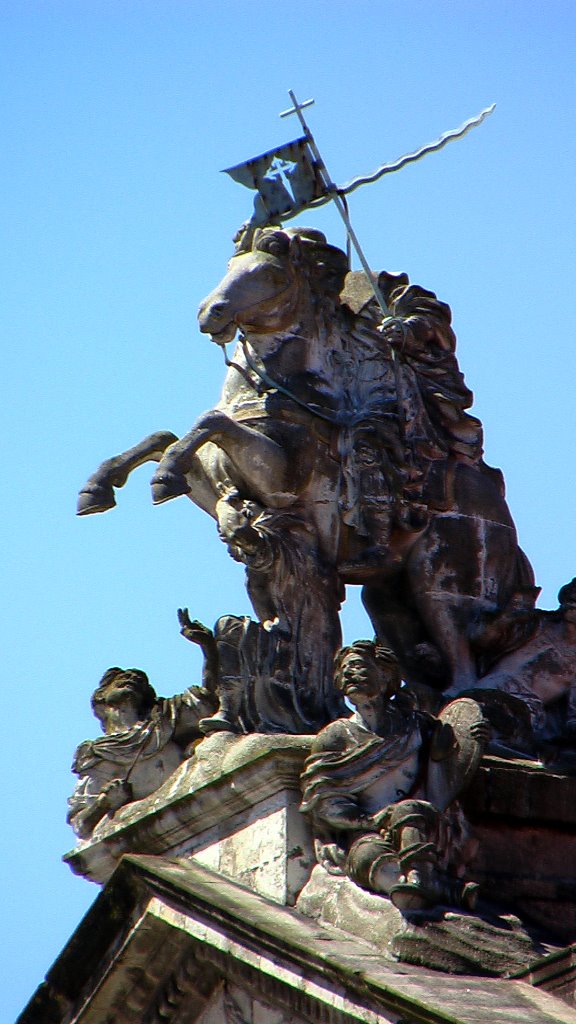
Today is the feast of St. James, after all. And if it is certainly anachronistic to speak of him as "matamoros" (Moor-slayer), that was one of the more unusual titles of the saint that we encountered in Campostela, I suspect that the Israelis would appreciate a heavenly warrior coming down on a white charger, such as appears on the pinnacle of the building across the plaza from the Cathedral. If it would be unchristian of us to hope for (God help us) a Moor-slayer, we can pray for the conversion of all those who resort to violence to achieve political ends.
Circumstances in Lebanon and Israel are escalating so quickly it is hard to believe. I just heard that one Hezbollah spokesperson spoke of the battle as the "Israeli-American War." At the same time, it seems that Israel really should not have taken Hezbollah's bait. The sheer number of rockets coming into Haifa indicates that the provocative kidnapping of the 19-year-old soldier was a sign of Hezbollah's confidence that they had enough weaponry and manpower to work more than mischief.
All this leads me to believe that war is Satan's most clever tactic. After all, the panic, disorder, violence and arbitrariness of death and distruction is what causes the contagion of hatred to spread among the innocent, especially the children, who will then become the "carriers" into the future. All the more reason to pray for a genuine cease-fire, prompted by reverence for the innocent on all sides.

Monday, July 24, 2006

St. Sharbel of Lebanon

Today's saint is one to invoke for his own homeland: St. Sharbel was a Lebonese monk, the Padre Pio of his time (1828-1898), noted for mystical phenomena. The prayer for his feast day is perfect for the situation in Lebanon today:
All-powerful God,
hear the prayers of St. Sharbel Makluf.
Increase your gifts within us and give us peace in our days.

Katrina update

Well, at lunch yesterday with some cousins and my one uncle who held out in his little bungalow throughout the entire hurricane and aftermath, I heard some of their survivors' tales, and also a few current events.
One of the saddest, that really brings out my inner redneck, is that once FEMA stopped paying for housing, a huge wave of criminals returned to the city, where they have been wreaking havoc. One relative on the police force saw her partner shot four times (and paralyzed) after a traffic stop--while she was putting the unlicensed driver of the car into the squad car, the passenger ran out of the car and around a corner, and shot the other officer from hiding.
On the positive side, there is a baby boom over here, and while the media identify "New Orleans" only with the actual city limits, we natives know that the whole area is New Orleans--and while the city population is diminished, the Jefferson parish population has increased, so that offers some hope.

Saturday, July 22, 2006

Prayer and Penance

Pope Benedict has requested that all Catholics observe a day of prayer and penance tomorrow, Sunday, for the peace of the Middle East. I don't need to stress how unusual it is for anything like this to be scheduled on a Sunday, the day of resurrection. It is a special indication of the gravity of this appeal that the victory Jesus won over sin and death may be brought to bear on the "pitiless conflict" in his native land.
 
Here's the Vatican Bulletin:
DAY OF PRAYER AND PENANCE FOR PEACE IN MIDDLE EAST
 
VATICAN CITY, JUL 20, 2006 (VIS) - Faced with worsening situation in the Middle East, the Holy See Press Office has been directed to communicate the following:
 
  "The Holy Father is following with great concern the destinies of all the peoples involved and has proclaimed this Sunday, July 23, as a special day of prayer and penance, inviting the pastors and faithful of all the particular Churches, and all believers of the world, to implore from God the precious gift of peace.
 
  "In particular, the Supreme Pontiff hopes that prayers will be raised to the Lord for an immediate cease-fire between the sides, for humanitarian corridors to be opened in order to bring help to the suffering peoples, and for reasonable and responsible negotiations to begin to put an end to objective situations of injustice that exist in that region; as already indicated by Pope Benedict XVI at the Angelus last Sunday, July 16.
 
  "In reality, the Lebanese have the right to see the integrity and sovereignty of their country respected, the Israelis the right to live in peace in their State, and the Palestinians have the right to have their own free and sovereign homeland.
 
  "At this sorrowful moment, His Holiness also makes an appeal to charitable organizations to help all the people struck by this pitiless conflict."
OP/MIDDLE EAST/...                                                                     VIS 060720 (230)

Friday, July 21, 2006

New Orleans

Home sweet home. Blue roofs still visible from the air, and a lot of destruction still evident, even in Metairie (the "less affected" area). But I went out with Mom and Dad for supper, and Dad said that the sport fishing has never been better. Not that he's a sport fisherman; he's just heard. Seems that the loss of commercial fishing has been a real boon to the regular Joes with rod and reel.
Hey, it's something positive!

Thursday, July 20, 2006

For those who do not know the life of Ignatius of Loyola like the back of their hand, Azpeitia is the town near the Loyola estate. It seems that the Loyolas used to have a kind of stone fort, but when Grandpa Loyola and the other local dons (no kidding) were putting pressure on the townspeople to continue the feudal ways, the townspeople, intent on a form of self-governing, appealed to the King (I don't know which King; had Ferdinand and Isabella unified Spain by then?). The upshot was that the King sided with the little people, exiled their Lordships to the frontier by the Moors, and had the fortresses torn down. The ruling class had abused their power, and were no longer permitted to have fortresses or castles. They could only build in brick.
So when Grandpa Loyola was allowed back to his torn-down fort, of which only the central tower remained--and only two stories of it, at that (and the ground floor of these things was always the stable), he got Moorish brickworkers in to raise the tower back to a decent height, and with a bit of class. It was in that tower-house that Ignatius was born, and although he left home very young (14 or so); it was to this house that he was carried back from battle, seriously wounded; it was in this house that he was converted to the Lord.
This was the goal of our trip: the "holy house" of Loyola--though, to look at it, you wouldn't know there was a tower or a house there. Those enterprising Jesuits built a basilica around it.
Even during Ignatius' lifetime, the first Companions revered the place where his spiritual journey had begun. It was here that Ignatius first perceived the movements of his inner spirit, leading him to eventually formulate the whole concept of discernment. It was from here that Ignatius (still Iñigo) set out to imitate the saints.
Finally, Karen and I had arrived. The credit cards were still a problem when we pulled up to the little Hotel Loiola, just down the road (literally, maybe a quarter of a mile) from the twoer-house and its circumscribing Basilica. My community had provided me with something for an emergency, and this qualified (we were, as I wrote before, in the middle of absolutely nowhere), so soon Pedro was on his way back to Navarre, while Karen and I lugged our bags to our rooms. (No helpfulness there--Karen thought the proprietor was a bit surly, but later we learned that the family may have just been embarrassed: people here do not necessarily speak Castillian, just the local language which is the oddest accumulation of sounds and syntax known to man.) After getting situated, we walked that quarter mile to the shrine.
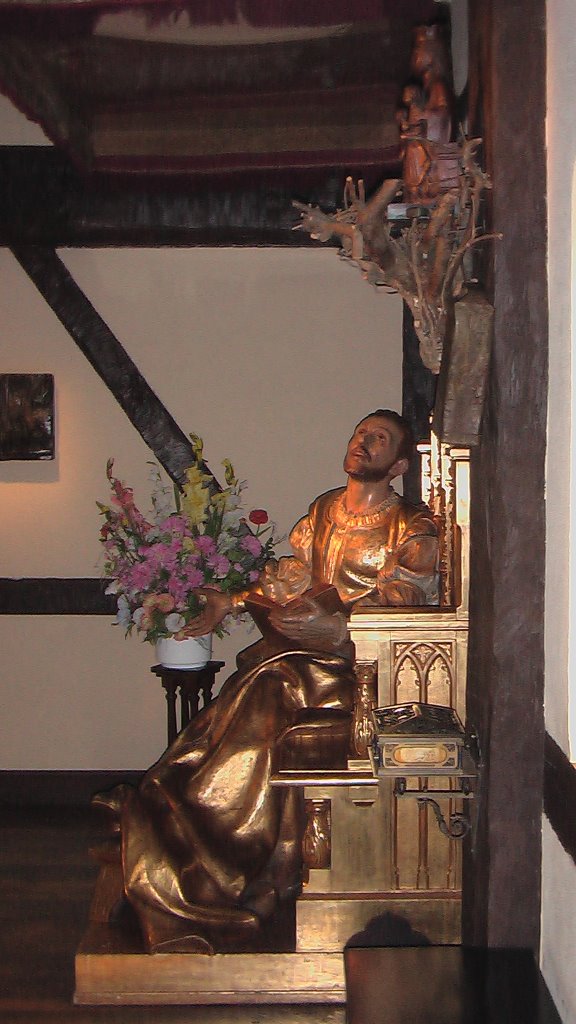
It seems it had been a relative of St. Francis Xavier who had transported the wounded soldier here from Pamplona. It was hard enough getting here by car; it couldn't have been an easy matter on a litter! We made a quick run through the tower-house, lest a Manresa happen to us. (Does that sound paranoid?) The "conversion room" was the highlight of the whole trip for me. Not only was this the place where Iñigo recovered from his war wounds (and then from the barbarous surgery he underwent without any kind of anaesthesia), it was where he succumbed to the influence of grace. A somewhat tattered canopy hangs from the ceiling (you can see it a bit in the photo); the evidence indicates that this was the canopy that hung over the patient's bed! And right there is a life-sized statue of a very well dressed young man of the Renaissance, seated on a bench, book in hand--with one foot resting on a stool. He is looking up rapturously, toward a tiny statue of Mary that is perched on a rough-hewn column.
More about that in my next installment!

Theology of the Body

Announcing, heralding, proclaiming, trumpeting, the new critical translation of the Theology of the Body, with never-before-published headings and content from Pope John Paul's own Polish notes. A consistent treatment, in the order Pope John Paul originally intended. Please get the word out!

Wednesday, July 19, 2006

fait accomplis

Yes! The first complete manuscript of the translation is now at the foot of the tabernacle, with the Founder's relic looking on, as a gesture of supplication that the project will do immense good.
I still have a lot of work to do on it, but now it is a matter of fine-tuning and finding the typographical hiccups. Mere details. Hundreds of them, but details, nonetheless.
And I was able to go with Sr. Helena and two friends from the Art Institute to see the move "Stolen," about the art thefts at the Isabella Steward Gardner Museum in Boston. I was in Boston when the robbery took place; the sisters had just visited the museum, and were so enthusiastic about it, and then poof, some of its greatest works were ripped away. The movie was quite interesting, because it brought you face to face with professional art thieves as well as the professional stolen art "detectives."  Worth seeing. Probably at an art theater near you.

The Way to Azpeitia

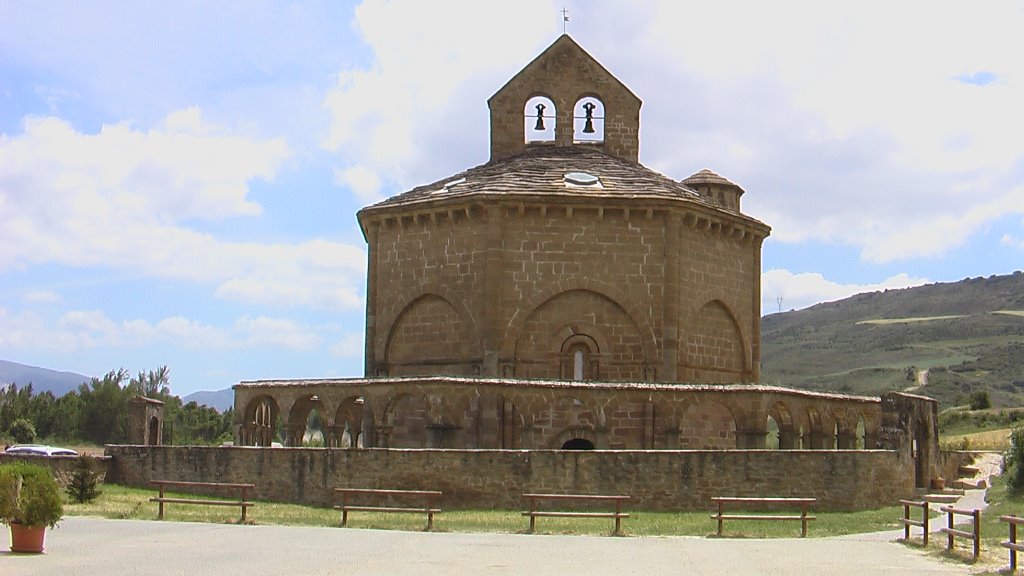
When we left off... Karen and I were in Olite. Barbara had gone to different province to meet a friend (who was flying in from Madrid just to spend the day with her). She didn't mind missing the visit to St. Ignatius' birthplace, the site of his conversion... just what Karen and I had crossed the ocean to see! Our destination was in the Basque Country, and on the way there, we had other things to see. First on Karen's list was a tiny Templar church outside of Eunate. It was fairly close: a small (garage-sized) octagonal church, with nothing more than a tabernacle (occupied) and a statue of Mary, seated and holding Jesus. Here we encountered our first "Camino" pilgrims, lean, brown, silent. Three groups of two (one group on bikes) pilgrims each, heading for Santiago, on the other side of Spain. A long stone building near the church had a sign marking it as a family home (no souvenirs or postcards!), but it was obvious also that the family hosts pilgrims for the night.
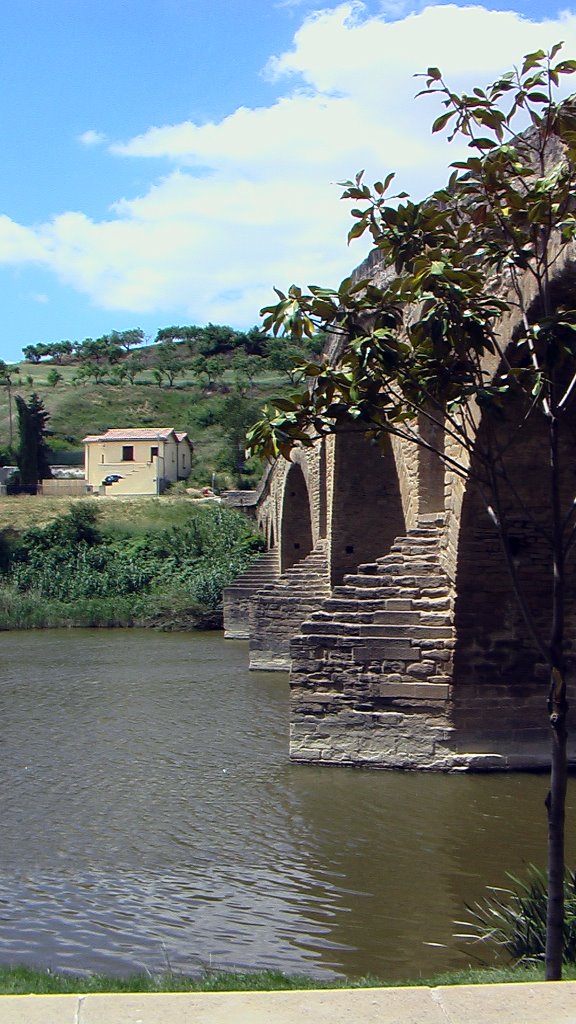
Leaving the town, we passed another group of pilgrims, and there were still more on a side street. We pasted the "Puente de la Reina" and saw pilgrims crossing on foot and on bike. I was feeling sheepish about our being in a car, until we passed two tour buses. Puente de Reina is a lovely, picturesque town. The Camino de Santiago passes right through it, and we paused here for about an hour. Somewhere in that hour, I lost Karen again. This time, it was not to a shop, but to the Roman bridge. She must have dozens of shots of it. In Puente de Reina we stopped in two tiny churches, also visited by the pilgrims. The church of the Crucifix is almost entirely bare and empty, except for its striking cross. Here, too, everything had been destroyed and (partially) restored. I also got a picture of several St. James statues; each church has at least one! (I was thinking of my Dad and of the several "Jameses" among my nephews--and my future brother-in-law.)
As we drove away, toward the Pais Vasco, the terrain changed. There were mountains of rock, but with thick stands of pine and here and there a swath of Roman aqueduct. Highway signs became bi-lingual: Spanish and Euskera (Basque). We found ourselves going off the highway and onto a winding single lane road in a forest, stuck behind a construction vehicle. We passed a town with a short, almost stubby stone church, heavy and solid, in a Romanesque style, and then back into the woods, with intermittent fields of moss-covered rock and grass and severely pruned trees. On a winding road, needless to say, between forest and pastures. Our destination was an extremely remote 5th century church dedicated to St. Michael and perched on a cold and very windy mountainside. Actually, the tiny 5th century church is inside a larger, 12th century church. We found the Blessed Sacrament even here. There was also, oddly enough, an "Osteria." I wondered how they could make a living up at the top of a cliff, but it seems that many tourists and pilgrims do make the ascent, as we had. There also seemed to be a large hostel that was not in operation. I took pictures and video footage of the quaint church(es), but few of the photos came out. (Par for the course!)
The drive allowed us to see several kinds of Spanish landscapes. Navarre was green, green, green, with pine trees on the hills all pointing up like the tips of feathers. The trees had been planted in stands, each kind of tree creating a different patch of texture on the hills, making them look like a piece of monochrome crewel, or a knitted work with different stitches. Tunnels took us in and out of the rocky hills. In the farming areas, we started seeing haystacks that looked like giant mushrooms. After a while, the squared-off buildings of stone, with red clay tile roofs and balconies edged in brick become normal. There were long-haired goats on a hillside, and on another slope, at the side of the road, I saw an old man with a scythe. The scattered towns had small industries, while just outside of them, there were pastures on the steep hills, and terraced farms, and tiny buildings like Monopoly houses.
Even with GPS (with a female voice!), our driver, Pedro Maria, was having trouble finding the small towns that we want to visit. Spaniards don't travel much outside of their own cities, and Azpeitia, it turns out, is in the middle of absolutely nowhere. Pamplona, on the other hand, is a real city, with an airport and everything. (Perhaps that is because the French won in St. Ignatius' crucial battle there.) But Pedro had the amazing ability to stop and ask for directions. More than once. A few more curving roads--and some near misses with speeding trucks that even made the driver cringe and hug the edge of the pavement--and we were in the Loiola valley, the town of Azpeitia, birthplace of Ignatius Loyola.

Tuesday, July 18, 2006

39 down, 4 to go

I mean for Stage 2 of my humongous translation project. Unfortunately, it is not a work that would interest too many people outside of my religious family itself, since it is an internal sort of publication, and rather dated. But I'm getting a lot out of doing the work, and hope to be able to integrate it and create a new synthesis with it, making our Founder's thought more available on a wide scale. At this point, I am ready, as I told my friends, to give up food and rest, just to reach the finish line. Yesterday I did three chapters, and I thought perhaps I could do the same today. Wrong! One chapter I tackled today had 20 footnotes, and one of them requires some consultation about the English title equivalents of works of St. Francis de Sales which are known by distinct titles in Italian... I am still waiting for an e-mail reply from a Salesian spirituality scholar who is fluent in Italian to help me get past that one. At this writing, I have chapter 40 mostly done (except for the footnotes; I hope there won't be 20 of them, too!). And once chapter 43 is done, I have to tackle (ugh) the index. Which I don't really know how to do. Probably in a database form, so it can be alphabetized later. And connected to the page numbers...
 
Anyway.
We had a lovely picnic cookout at a friend's apartment by the lake, and as we finished, an impromptu fireworks display went on by the lake. Perhaps they were practicing for Chicago's upcoming Venetian night, because it was better than the Fourth of July. And Sr. Susan loves fireworks. (So do I!) A sweet surprise from Jesus.

Monday, July 17, 2006

The Gaymes in Chicago

If you're not in Chicago, you may think that was a typo up there. It's not. Our fair city is hosting the "Gay Games," a combination of gay pride and sports events (plus cheerleading and choral events). Sr. Helena said she noticed some protesters holding signs sying things like "Repent." (I seriously doubt that this is what Jesus had in mind when he called all of us to repentance.) But I was still having a really hard time figuring out why a sector of society needed its own faux Olympics (will they have ever have "chaste games" so I can play?). An article in yesterday's Tribune shed a little light on the matter. (Living, as I do, in the rarified atmosphere of the convent, some things don't occur to me.) Anyway, one of the persons interviewed in the paper commented that he would like to play football and so on, but the chatter in the field usually hovers around subject relative to the attractiveness of persons on the sidelines. Someone who doesn't share that attraction is in a pretty awkward position. It just contributes to a person's sense of "not belonging." And the "Gay Games" are an attempt to address that.
I would like to suggest another approach. It is an old approach. It even has quaint names. But it is part of the Christian vocation, and if outfield chatter tends to focus on certain topics, it could mean that the Christians in the outfield are failing to take their vocation seriously.
Because the answer to our hyper-sexualized dominant hetero culture is not simply to have occasional mass gatherings of a different, but still hyper-sexualized culture. The real "antidote" is a thing called modesty. Or "chastity according to one's state in life" (I told you it had quaint names). Chastity does not mean "celibacy." Celibacy is a way of living chastely, for those who are not married. But there is definitely a chaste way of loving that is also part of sexual expression. And it is seriously missing in the usual discussions and assumptions about human love.
Just yesterday in the Office of Readings, we heard St. Ambrose telling the recently baptized, "You renounced the devil and his works, the world and its dissipation and sensuality." These (dissipation and sensuality) are characteristics of something that the Christian is presumed to have renounced.
Are we, by a vibrant witness to Christian purity, telling our society that there is really good news to be found in Jesus? Or do we need the signs of those sincere protesters to be turned toward us, calling for repentance?

Losing your life

Today's Gospel is a collection of really hard saying from Jesus saying, basically, "Either I'm #1 in your life, or you don't have a life!" That "whoever finds his life will lose it and whoever loses his life for my sake will find it..."
That line tends to transport me to Philippians 2 and 3. In chapter 2, with the phenomenal hymn to Christ, the self-emptying slave, we see Jesus "losing his life" for our sake, and "finding it" in the resurrection. In chapter 3, we see how Paul "accepted the loss of all things" in order to "gain Christ and be found in him"--in other words, to find life.
"Losing one's life for the Gospel" is the primary mystery of the earthly life of Christ. So in our case, it becomes finding life in Christ--finding that Christ is life!

Saturday, July 15, 2006

Olite: Fit for a King

The continuing adventures of a bold Ignatian pilgrimage...
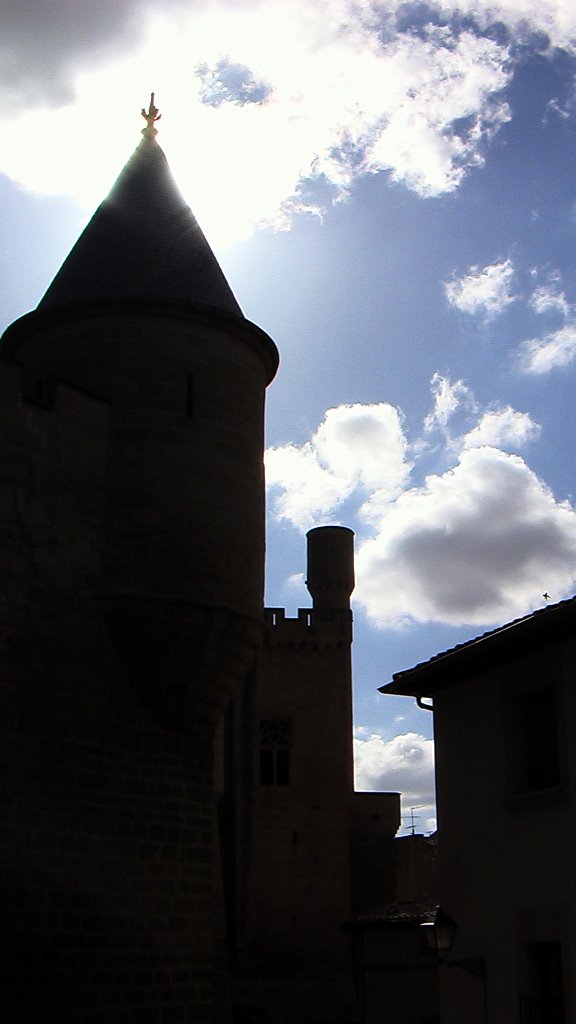
After the Xavier castle, we headed to our first parador.I had no real concept of what a "parador" was. What a way to find out! Turns out that paradors are ancient institutions that have been renovated and turned into hotels run by the Spanish government (a model of efficiency--and no, that is not being facetious). When we drew near the town of Olite, the most striking thing on the horizon was the majestic castle of "Charles the Noble," King of Navarre. Work was being done on one of the outer walls, and we had to drive around the city looking for a way into the town itself. We went down a narrow road that opened into a plaza dominated by the battlements, towers and turrets of the castle. That was our parador. We later learned that the castle had been reduced to a rocky rubble pile of ruins, and had been completely restored. (Archaeology is a great career choice in Spain.)
(Note the view from my room, to the right.) After checking in at a front desk near which stood a complete suit of armor , Karen and Barbara went into the plaza in search of an ATM, but came back empty-handed. Barbara had even attempted to extract money from a video-return box that was guarded by an ugly, toothy dog. This was the beginning of the "Ignatian" part of our trip. Good thing we didn't know what was coming in that regard! We made reservations for dinner in the parador restaurant, located in what was probably part of the Castle's great room. When the time came, we found service rather poor. It didn't help that Karen asked the head waiter if they had sangria. He could barely even get a "no" through his disdainfully pursed lips. (Turns out that Navarre is the principal wine-making region in Spain, and they don't do that to their wine.) We had a great meal anyway, taking in the surroundings, from the massive light fixtures to the triple-sized fireplace. And then we said good-bye to Barbara--we would meet up with her in two days, but for now she was going to meet a friend in Asturias. Karen and I would visit Ignatius' birthplace without her.
The next morning, Barbara having left at 5:00, Karen and I went to Mass.
The parador staff told us that there would be a 10:00 Mass at San Pedro, so we headed there, stopping every few steps for another Kodak moment. (When you spend the night in a 15th century castle, there are lots of Kodak moments on the way anywhere.) We found San Pedro, but the old church was locked. We went all around to see how to get in without any luck. I saw an old man go by on a motorized cart and suggested that we ask him--or at the pharmacy across the tiny plaza (Karen was our designated local-language person). So we followed the old man (and his tiny puppy) in. As I glanced out toward the church, I saw a nun walking by. Without even alerting Karen, I ran out after her. "Hermana?" She turned, and I asked a one-word question: "Misa?" She pointed back to the castle we had come from. Mass would be at the Castle Church of St. Mary, not at San Pedro. (Evidently the local Mass people maintain their own information network, and the parador is not in on it.) Karen let go of the few items she was about to purchase, and we followed the nun back to the chapel of St. Mary. Immediately, the lights went on, and an enormous retalbo was lit up. It had clearly been refinished or even repainted in recent times, but it was breathtaking in sparkling gold. The Mass began, and the priest opened with a hymn. The whole assembly joined in, and they were good! The old lady behind me had an exceptional voice, but overall the people sang well, with a unified voice, clear, echoing in the small Gothic church. After Mass, the lights went out. We tried to get a few pictures anyway.
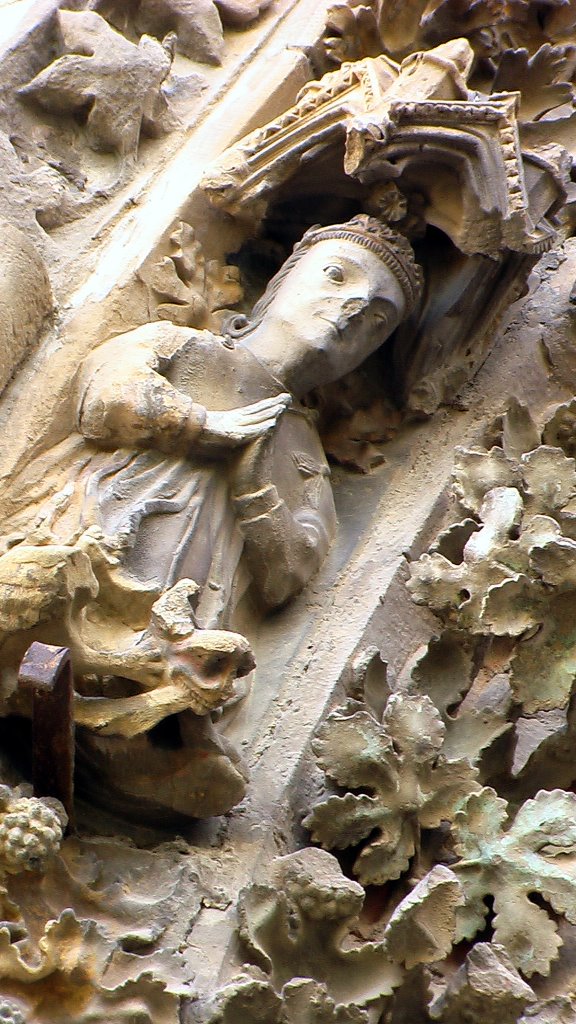
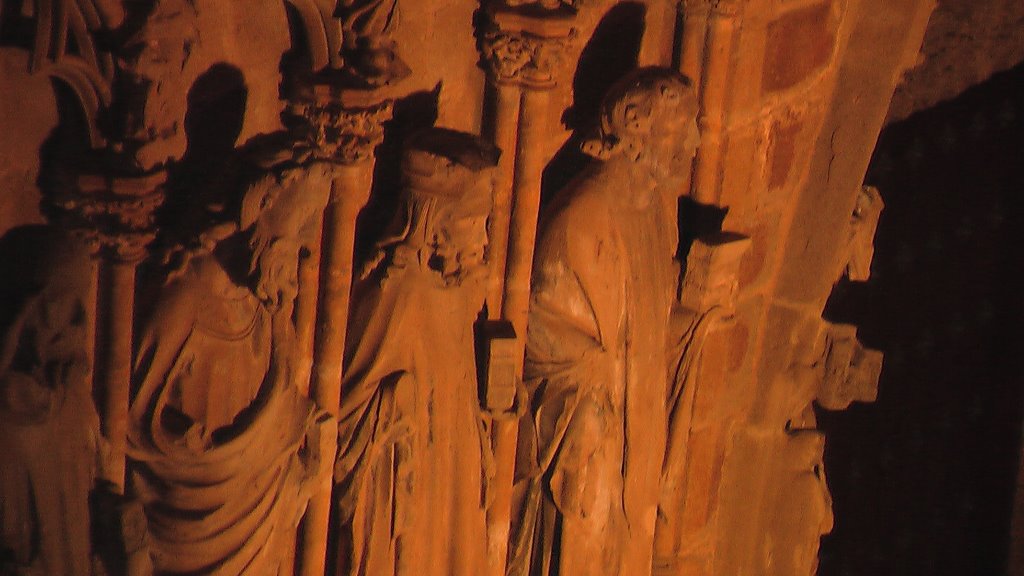
The facade of the chapel was covered in statues (see photos, including the night shot taken through a window in a castle stairway), and in front of it there was a kind of patio surrounded in gothic arches. It is interesting that all my life I understood the word "gothic" to refer only to a style, but here, the word is a very specific historical designation: it really means "the Visigoths built this"!
After Mass, Karen ran to her room, while I stayed outside. (This was not a "waiting for Karen" episode, however: I didn't want to go in the building when I could enjoy the sunshine.) A group of school children, about 11 or 12 year-olds, greeted me. I apologized that I could only greet them in English. Well, that got them excited. They swarmed around me chattering, with a few words of English here and there. The first thing I understood was that their English teacher, who was named Orlando or Rolando, was fat! They stayed there, trying to communicate in English and Spanish, telling me their names. Even a teacher came by and was excited to speak with an American sister.
Then Karen came out and together we went looking for...an ATM! Well, no luck. We tried a bank that proudly announced that they do money exchanges. "Oh, we don't do currency exchanges here. Try across the street." The place across the street would only do it if you had an account with the Bank of Spain. But then a manager intervened, and we were at least able to change our dollars into euros. Kind of important. None of Karen's credit cards were working, and it was still nighttime in the US, so no one there could do anything about the situation. We were on our own.

Friday, July 14, 2006

winds of war

"Boinky" responded very forthrightly to my blog post about the fomenting of war, so I thought it would be well to nuance my post a bit. I know that the churches do not teach this weirdness, and while I do not read Andrew Sullivan or Slate (or many other PC publications) on any kind of regular basis, this is something I have sort of "gathered" in general from simple attentiveness. Even when the "Left Behind" books came out and were reviewed, and then the movies, I had this gnawing sense that the way the plots were developed was strangely martial. As a Catholic, I have to deal with the whole issue of the Crusades--"holy wars" fought with great violence, as if the Kingdom could be brought about with the sword. We see this same presumption in the middle east, and I think the same mentality is probably at work in some of these fringe groups in the evangelical branch of the Church. From what I understand, there are several movies (not the 'Left Behind" ones, but movies done in the 70's or so) that express the same bent theology; a friend of mine in the movie business tells me that these videos are still among the best-selling titles on the market, even though they are very poorly made. They are in the "Biblical prophecy" genre. Now, even without actual denominations (outside of some really fringe-y groups) teaching these things, many individual believers can be led, and possibly are being led, to take on this mindset almost unawares, and to use it as a kind of interpretive screen, or add it to the uncritical assumptions through which they automatically filter their religious and political thought. This is not limited to people in the evangelical churches: many Catholics seem to do the same thing, uncritically accepting these interpretations as if the Catholic understanding of the Scriptures was deficient in this particular area. They just accept it, without even asking if such a line of thought had any basis in the history of biblical interpretation, or was in any way supported by solid theology!
So I am in no way criticizing churches for this situation; it is a problem of our individualized society, in large part, which allows the person with the most access to media to have the equivalent of a university chair from which to teach with authority, even if there is no authority whatsoever behind them.

Thursday, July 13, 2006

Hellfire and salvation?

Father Kavanaugh's piece in the latest issue of America (on the Barbarism of War) coincided with an RNS review of the book "Skipping Towards Armageddon."  I would really encourage you to read both, especially in the light of today's Gospel (Jesus' instructions to his newly-minted apostles).
Jesus tells the twelve to heal the sick, raise the dead--in a word, to restore life. But some of our more deluded Christian brethren seem to be basing their faith-life less on the Gospel of the Lord than on (peculiar interpretations of) the Book of Revelation. This leads them to believe that the day of the Lord will be hastened by violence and warfare. In other words, that we can "force" God's hand and "make" Jesus come again by putting all the pieces in place for violent conflict in (where else?) the Middle East (where "Megiddo," the original "Armadeddon" was).
What this tells me is that it is more important than ever to proclaim the Gospel. Loud and clear. And faithfully.

Rx for Catholic Guilt

Last night I was reading a meditation our Founder preached in 1935 on the topic of "Sorrow for Sin." You would think that something on those lines could really foster an unhealthy sense of remorse, the kind often called "Catholic guilt." Instead, it hinted at why so many of the saints, including our Founder himself and people of the stature of Pope John Paul, went to confession every day. They learned that our failures in life give Jesus the opportunity to show us his love. So instead of repressing their shortcomings in the life of grace (even things that would probably not qualify as sin, strictly speaking), they welcomed the occasion to show their poverty to Jesus and let Jesus shower them with mercy. It is as if, since Jesus has already won the ultimate victory, he sees our sin only as another place where he can bestow love on us.
That is so different from the approach to spirituality that would have us focus on "removing" sin (as if!), and which can lead to all sorts of neurotic behavior. Instead, it becomes a matter of "recognizing" the hold sin still  has on us, and "presenting" it to the Lord, who is delighted to bend toward us to take that sin away.

Wednesday, July 12, 2006

I take it back

It was Windows after all. As I attempted to shut down last night, the same window-freeze took over my computer, and I realized that while I may not have installed anything new in my computer that day, I had run the Windows Update. See? All my decisions yesterday went bad on me! As I told my friend, Brother Fred (of the Claretians), the only thing I didn't do wrong yesterday was get on the ill-fated Blue Line train. But I hope to at the end of next week, when, God willing, I will make my home visit! We'll see...

Tuesday, July 11, 2006

The Lord gives...

and Windows taketh away.
Well, it's not fair to blame Windows for the fact that I had eight pages of a chapter done before 1:00 and suddenly, with no provocation on my part, my computer screen was suddenly transformed into a work of modern art consisting of numerous thin vertical lines. And no responsive anything. God be praised, by the end of the day I had recouped the work, but that was all. And since I had made a commitment this morning to do a massive clean-up job in our book center entrance (the doorway is used, to put it delicately, for purposes other than ever intended, with odiferous results), I couldn't even promise myself to come back and finish the chapter. In fact, we just ended now. The heavy, carpeted mat that was the principal victim of our efforts is balanced on its end in the garage, and I really am pushing it to post this blog and see if anyone in the world wrote to me today.
St. Benedict tells me, "Prefer nothing to the love of Christ." Not even progress in a very holy project!

Monday, July 10, 2006

Javier


First, the mystery of the name. How do you really say it? "Javier" is pronounced Hahv-yayrh. It is the "Spanish" way of writing and saying "Xavier," which is pronounced "Zhahv-yehr"(with the "Zh" representing that sort of buzzy "sh" sound you find in French, as in Jean Valjean). The Basque language abounds in X's and K's, but the X's are rather soft.
On our way from Zaragosa to Javier (from Aragon to Navarre), our driver pointed to some cyclists on a path to our left. That path was the Camino de Santiago, and the cyclists were bike pilgrims. They were our first glimpse of Cammino pilgrims. We would see many in the next several days.
Finally, signs started to indicate that "Javier" really was getting close! Karen was still fiddling with her camera, over which we had all been praying. I said a short, intense prayer to Blessed James Alberione, reminding him of his promise to look after those who dedicate themselves to evangelizing with the media, and then I suggested that Karen take the lens off and then replace it. Praise the Lord! The error message went away! And Barbara had the nerve to insist that it was HER prayers to the Blessed Mother that had obtained the critical grace. (Oh yeah? Then why was it MY suggestion, after praying to Bl. James, that worked the miracle?) It would be an ongoing question. But this was the first chapter in the life of Karen's "magic camera." We wondered if we going to experience another Manresa, getting to the Xavier castle just as it was closing, so as soon as we pulled into the parking area (a good distance from the castle itself), we started striding down the road.
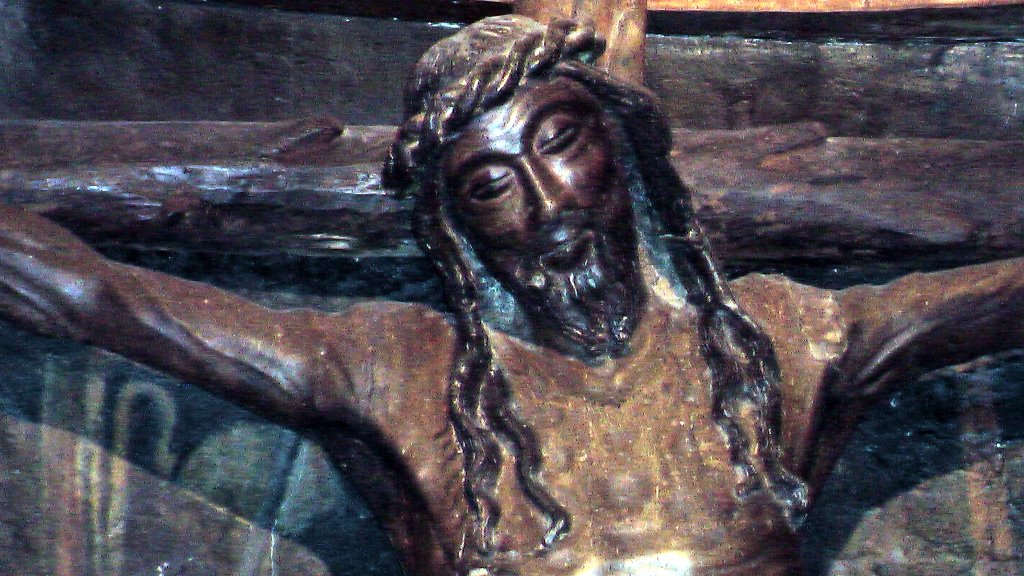
The Xavier castle (as you can see) really is a castle-castle: turrets, battlements, drawbridge, slits in the wall (even in the chapel!) for shooting arrows at your oncoming enemies... And this is where the future missionary grew up. The former stables, running in a semi-circle around the lower level, have been transformed into a museum. Everything is pretty bare, actually, although one room was furnished as it would have been in the early 1500s, and the family chapel is as it was then, with a large Christ Crucified whose expression is so serene, it is called the "Smiling Christ," and the frescoed walls covered in dancing skeletons. (Who could fear death, having learned to pray in such a setting?) The chapel is narrow and small--maybe eight people could stand in it comfortably--with a rounded apse area. Rather incongruously, the exterior door near the chapel leads to an outside "patio of arms" where soldiers and horses would have been mustered for battle. An earlier building that would have been known to St. Francis was torn down in the late 1800s to build a small basilica. I have to hope that the building was irreparable; it seems a pitifully stupid thing to tear down part of a saint's house in order to build a church--especially, as it turned out, when that church takes attention away from the parish church built by the saint's own parents on their property, which is still the parish church of Javier.
We didn't even know about that other, older church, where St. Francis had been baptized, but as we were taking some final pictures of the castle, Barbara was approached by a friendly man who spoke English. He turned out to be Father Antonio Falces, SJ, the parish priest of Javier, a native of the town and graduate of the vocational school built (by the same person who commissioned the basilica) behind the castle. He had been in India for 38 years. (That certainly explained the English!) Father Falces explained that the parish church had been built by the Xaviers on (and with) the ruins of an earlier church. The rectory and courtyard were also built by the Xaviers. Even though the 1901 basilica gets all the attention (even from Jesuits, who tend not to notice the teensy church with the pagan or early Gothic graveyard with its strange round stones poking out of the ground--one of them even carved with a pentagram!). The courtyard featured interesting cobblestones which we would see throughout the rest of the trip. We went into the church (it had been ruined and rebuilt yet another time since Francis' childhood) to see the statue of Mary that Francis would have venerated as a child, and also the very ancient baptismal font where he became a Christian. It had been covered with silver bas reliefs, but all the precious metal was stripped away by Napoleon's army (the same team that demolished the monastery at Montserrat). Above the baptistry was a loft where the local community of sisters were beginning Evening Prayer, so we continued our visit as silently as possible, but for the click of shutter buttons, and then slipped away.
We were going from one castle to another. Our next destination was the town of Olite. We would be spending the night in the castle of the Kings of Navarre.

Saturday, July 08, 2006

Pilar

If my favorite place in all of Spain was the "conversion room" in the Loyola family home (coming in another two or three travel posts!), Barbara's was Zaragosa's co-cathedral of Our Lady of the Pillar. That was our next destination, even though we only had a couple of hours to spare for it if we were ever going to get to the Xavier castle! First, however, we had to get there. That meant driving through a desert with dry, shale mountains stubbled with shrubs and scrub. The overall impression was one of gravel, or of whites sands like Los Alamos. And yet in between these expanses are fields of lovely wheat! Since Barbara had done a lot of research here for her screenplay, she filled us in on the history. Apparently, during the Spanish Civil War, the two sides (neither of which had the resources to win) aligned themselves with two larger, European powers. Unfortunately, those powers were the Nazis and the Soviets, neither of whom had any abiding interest in Spain's future, but both of whom had designs on the rest of Europe. So they used the dry plains of Aragon for target practice, preparing for the aerial technologies that WWII would "need." Villages were reduced to the piles of rubble we saw here and there. Big piles of dry, stony rubble, often with a church incongruously visible. Barbara said that after the war, Franco attempted to bring back the past by having the churches rebuilt, even if the town wasn't. And even in the great churches that were restored, you can tell the difference in workmanship between the medieval and later forms and local styles (which are very distinctive) and their rather clumsy modern replacements.
Anyway, we spent a long time in the desert, and finally, the oasis of Zaragosa appeared, and the towering silhouette of Our Lady of the Pillar. Barbara started absolutely squirming with excitement. We arranged to meet the driver in two or three hours (he went to get directions to the Xavier castle in Navarre), and headed across the cobblestones of the plaza towards Our Lady's shrine with its remarkable multi-colored tile roof. As we went, Karen unclipped her camera bag and reached for the exquisite camera which...fell to the ground with a heavy thump. Ugh. Hoping for a miracle, Karen gave the shutter a try, but (this being a digital camera) all she got was an error message. There was nothing we could do--and we hadn't even reached the Basque region (Pais Vasco) yet! Well, our Lady was right there, so we traipsed over the stones of the plaza. That's where I basically lost Barbara and Karen for over an hour, to the point where I became very nervous. Turns out they were in the gift shop. (If you can't shoot, shop!) Well, I had taken a ton of pictures, hoping for the best, since the church was so large. I aimed my camera at the Virgin of the Pillar, at the bombs the Nazis sent into that very church (full of their prisoners)-the bombs that bounced on the marble floors and are now hanging, like victory tokens, on either side of our Lady's central shrine, at the immense organ and music book, at the three-story high alabaster reredo. I prayed, I kissed the pillar (where Mary is devoutly believed to have appeared to a discouraged Apostle James), I wondered if I would ever see Barbara or Karen again. This was one church that was spared desecration by its own people: none of its side altars were stripped bare; no poorly executed painting or large but tasteless 20th century statues filling (or trying to fill) the side chapels.
When Karen and Barbara reappeared with their shopping bags, we headed to a small restaurant for lunch. The place we chose had outdoor seating and was evidently located above or very near some ancient Roman ruins. Our cheerful (and somewhat insolent) waiter made recommendations that we were happy to accept; Karen stuck by her decision to have paella everywhere. And we had a bit of an encounter with a gypsy girl (and baby) who took advantage of our exposed position. I have to admit having a very hard time being able to name anything particularly positive about the gypsy culture. It seems so abusive toward women, and yet you see young, young mothers with babies (and sometimes older kids) on their lap begging, and you know there is not much of a chance that it will even occur to their girl children, once they are older, that they don't have to live that way. I really think that persons who are especially active in matters related to women's rights have a really worthwhile mission to fulfill on behalf of the female half of the gypsy population--to set up micro-credits, education, child-care that will allow women to really be liberated from the slavery that is all they know. (Any volunteers?)
Back to the cobblestones, our driver soon appeared, with clear (he thought) directions to Javier, only he was insisting that Javier was not Basque, and Karen and I knew very well that St. Francis Xavier was as Basque as St. Ignatius, even if they were from provinces that took different sides in the battle at Pamplona. Turns out we were both right. The driver probably meant that Javier (the castle, not the man) was in the Province of Navarre, not in the Pais Vasco.
Interestingly, to get to Navarre, we crossed not Aragonese wheat fields, but rice paddies!
Note: I have attempted three times to put pictures into this post, and it is getting too late for me to try again, what with multi-tasking other things as well. So come back Monday to (God willing) see what I am talking about! And maybe I will even get to Javier by Monday night!

Friday, July 07, 2006

Yippee!

I did two chapters of translation work today! That puts me squarely in the middle of the second stage of the three-stage process (assuming the Provincial can find someone to... go through the whole work with a fine-toothed comb for consistency issues--and to make sure I didn't drop any sentences that I haven't picked up on the second or third go-round)! Anyway, I really overdid it finishing that second chapter, but it was so enticing, knowing that it was the midway point. Turned out to have the most monstrous footnotes in the whole book (so far, at any rate).
Tomorrow I will probably be more moderate. That will also give me a chance to look at the hundreds of photographs from Karen's surprise package!

Thursday, July 06, 2006

Maria Goretti

Every so often, the community fax machine brings with it a notice from the Generalate in Rome: a one-page write-up about a sister who has just died. We got one of them yesterday.  A very elderly sister, born in 1913 and in a semi-comatose state for the past ten years, had died in our nursing-home community in the Alban Hills outside of Rome (near Castel Gondolfo). "Maestra Placida" was from Maria Goretti's town of Corinaldo. It was her mother who had been the first neighbor to assist the mortally wounded girl.
Poor St. Maria Goretti! After a painful (horrific) martyrdom, she has largely been written off by political correctness. I have heard that we should not hold her up as a model, because (it is said) we are, in effect, telling girls that death is better than rape. But that is not the point at all. Alessandro, her attacker, had attempted on several occasions to seduce the fatherless girl, and she had rejected him flatly because of the immorality of his suggestions. It was just that this final time, he was prepared to force her--and she fought back. In the end, of course, she won the paradoxical victory of martyrdom.

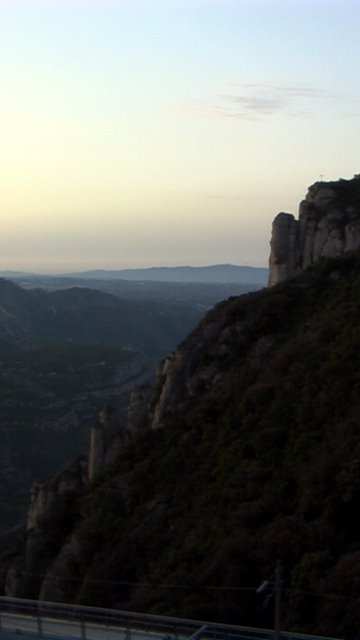
Montserrat

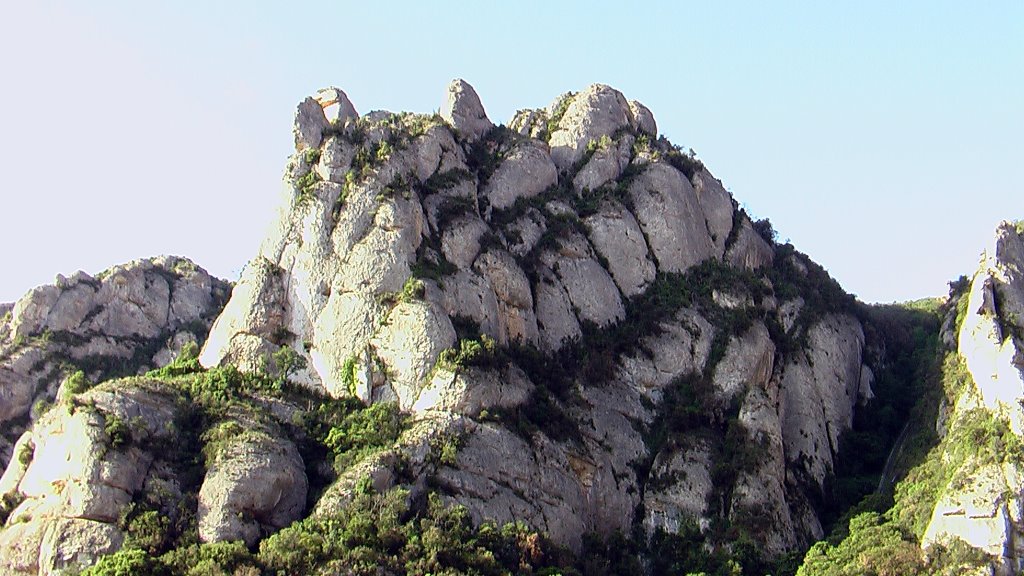
To resume my "travelogue," we must go to Montserrat. I got my first glimpse of this venerated mountain as we were driving out of Barcelona. My seat faced backwards, so I could see the towers of Sagrada Familia, and some time later, taking in the terrain, I noticed the oddest sort of mountain. It was towering and bald, but with smooth, vertical reaches. In fact, it was so unusual I took some video footage of it to show the sisters back home. Little did I know that it was our destination! But after we left Manresa, we began and upward climb that seemed to last forever. Barbara had already begun making smart remarks about Ignatius' staying in his office in Rome, so Karen and I made sure to point out how difficult a road this must have been for someone with a crippled leg (even though at the time, Iñigo had a donkey--he would leave it at the monastery). In fact, Montserrat is a popular destination not just for pilgrims, but for hikers and rock climbers--and Sunday is the big day. (Frankly, I can't see making that huge ascent just for a day trip.) We continued rounding the steep hill, barely seeming to have a foothold, as we went higher and higher, until the valley below seemed more like a mirage than a place we had actually been ourselves not that long before. We even wondered if we could possibly be in the right place: could there really be a monastery beyond us? Was there anything up there but rock and trees and sky?
There was.
The monastery is an ancient one--Montserrat has been a "holy place" since time immemorial, so it was natural for the Benedictines to establish a house there. It is built into the raw mountainside, a place of refuge and a popular Marian shrine. It was here that our pilgrim had "determined on a watch of arms throughout the whole night...before the altar of Our Lady of Montserrat," and here "he arranged...to have his sword and dagger hung in the church at the altar of our Lady."
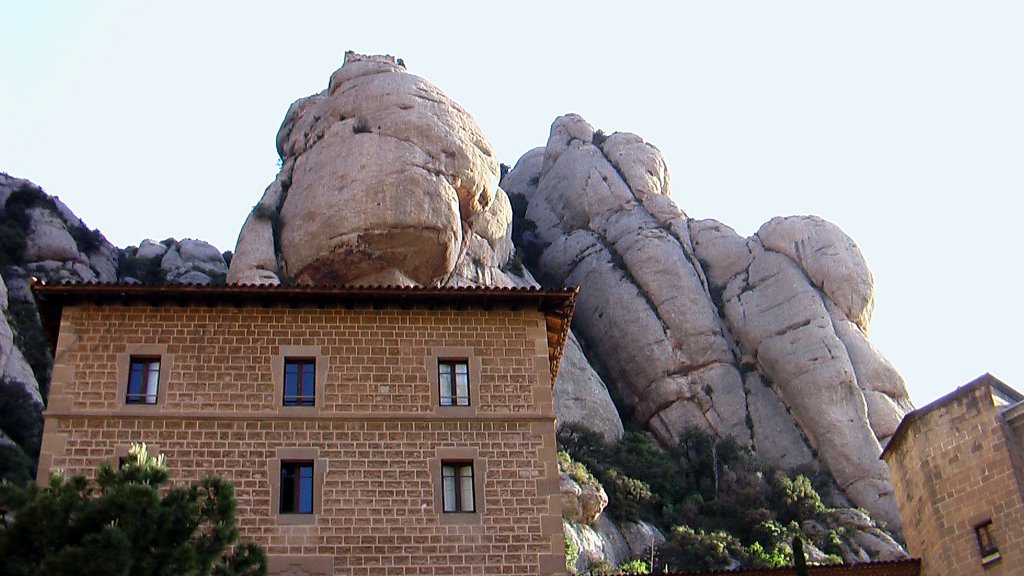
We had reservations for the on-site pilgrims' hotel, and our accommodations were lovely. From my window, I could look out on the strangely "serrated" mountains that give the region its name. The huge bells echoed the hours--you can hear the bells on the Shrine's website. We were able to attend Mass in the side Blessed Sacrament chapel. It was a tight squeeze, but a real blessing. (Remember, Karen had been pretty ill that morning, but she didn't want to miss Sunday Mass.) The chapel was bare, except for a modern (not entirely devotion-inspiring) crucifix. (At least, I think it was a crucifix of some sort... my memory could be fading.)
The visitors' area has a large cafeteria, but it was closing by the time we got there (we barely had time to buy the bottled water we needed). The gift shop is immense. I found a pretty one-decade rosary that was just right to bring to the staff, plus a book about the shrine. Karen found many wonderful things, including previous, finely carved wooden statues of Our Lady of Montserrat which she gave to me and Barbara. (Mine is now on my little altar, with a first-class relic of St. Ignatius at her feet.) The hostel basement-level restaurant was also picturesque, and the food was delicious, even though the service that first night was so slow we thought we had done something terribly offensive to the wait-staff.
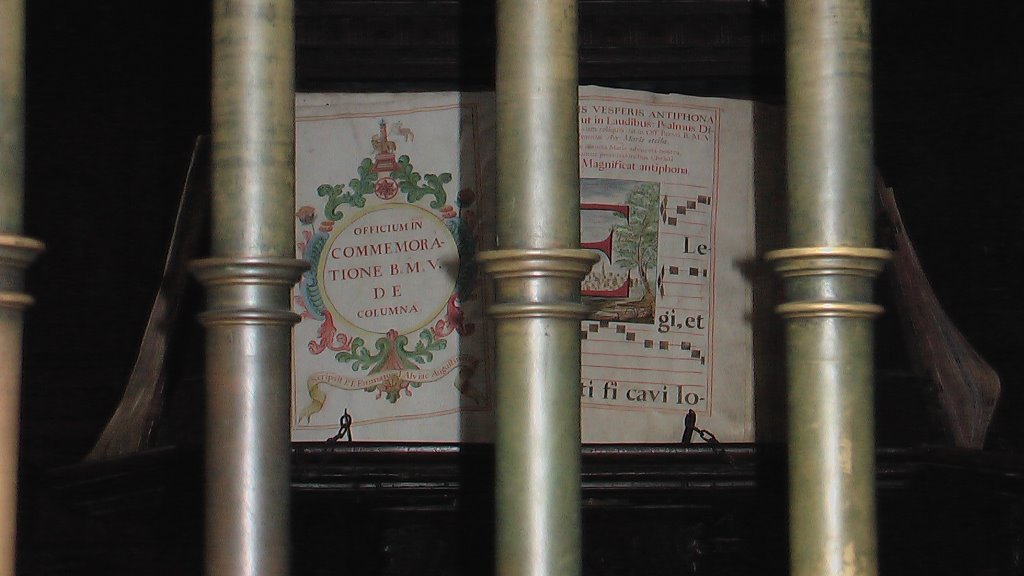
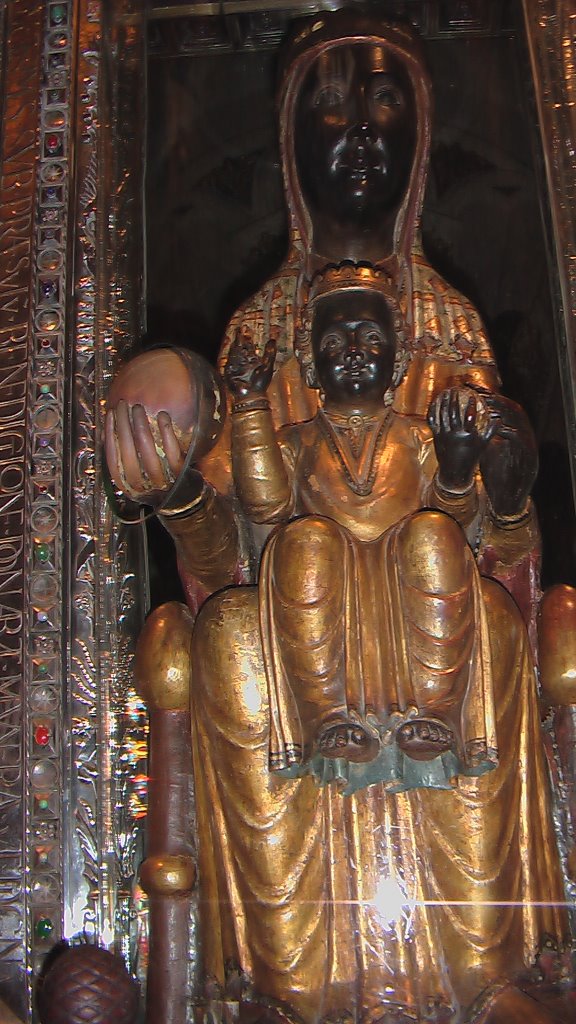
The statue of Mary that is venerated at Montserrat is one of Europe's "Black Madonnas." It is a romanesque statue, very stately, with Mary seated on a bench-like throne, holding Jesus in her lap. Her right hand is extended, holding a globe, and the left is also somewhat extended, as if designed to hold a taper. Now the statue is surrounded with plexiglas--all but the fingers of Mary's right hand, and part of the globe. Visitors climb a marble staircase (with an arched ceiling entirely covered in gold mosaic) behind the principal altar to venerate the statue. Traditionally, this is where newly married couples came to entrust their married lives to Mary, and women came to pray for safe childbirth. While I was waiting for my turn, just a few steps from the statue, I watched a Spanish family (Mom, Dad, four children and Grandpa) go before Mary. The youngest child was barely a year old, and his mother put his little head near Mary, to kiss her hand. Then Grandpa took the camera and the family posed with Mary for a picture. It was just too charming!
As remote as it was, Montserrat was not spared pillage. We did not see the shrine and monastery Ignatius would have known, and which (it seems) he came to on a regular basis for spiritual direction while living at Manresa. These were destroyed by the French army. This was not the last desecration. During the Spanish Civil War, the statue of the Virgin was hidden away safely, but the monks were martyred. It is hard to know how much of what we saw was actually a restoration--probably most of it. The mosaics in the area around our Lady's statue are of 20th century provenance (attractive, but definitely contemporary), and the side chapels have that barrenness that testifies to earlier desecration, but the entire shrine church itself is spectacular. (There is simply no other word for it.) There is a boys' choir and choir school, which I didn't really know about until too late--although by Divine Providence, I went into church to make a visit just as this famous choir was singing a final hymn. (They were spectacular, too.) I made three visits to our Lady's statue, and each time I discreetly tried to take pictures. Only the ones I took with Karen's camera really came out well. Happily, one of these is of a stained-glass window right outside the Chapel of the Virgin. It depicts Iñigo the Pilgrim. (Thank you, Karen--again!)
We stayed in Montserrat only until mid-morning, so all of us tried to get up as early as possible, in order to benefit as much as possible from the remarkable location. Karen delivered her camera over to me and I went crazy taking pictures of the scenery and the architecture, and then, when I could do it without scandalizing anyone, of the Virgin (and of that stained glass window!). (I can see Karen plowing through all the images on her memory card: what's with all these gargoyles? all these facade pictures? doorways? arches?)
But on Monday we had other plans. Monday was to be the day of two castles. One was at a place called Javier, or, in the local Euskadi language, Xavier.

Wednesday, July 05, 2006

Taste Test

I spent the Fourth with my sister and her fiance, getting to meet him for the first time. (This is the trailer repairman my sister would never have met if Katrina hadn't washed her out of her house...) Now they are in Michigan, where she is meeting his extended family. God bless them all.
There was a little item in the paper yesterday that seemed totally inappropriate for the anniversary of the Declaration of Independence. There is a week long food festival in town, the Taste of Chicago, in which some 50 or so restaurants offer three or four speciality items from outdoor booths. It's crowded, but yummily fragrant with the smoke of barbeque wafting across the park, and there's a generally jovial atmosphere. Marketing groups also take advantage of the huge gathering to promote new products, so you can pick up free samples of whatever is being offered. (This year's pickings are rather slim: Sensodyne ran out of free samples in a few hours after the event started, so all there was left of their presence was a sealed-up Sensodyne trailer; we got a lot, I mean a lot, of samples of Fiber-All, though...) Anyway, the Army is also set up with a painted Hummer, a trailer, a booth where you can get dogtags made for you, and guy-related activities. And on July 3, some people were arrested near there for protesting the war without a protest permit.
I don't know how they were protesting. I had seen some people the day before dressed in identical T-shirts with tasteful peace slogans, handing out literature. I don't know if it was this group or someone else doing something a little more objectionable than what seemed like the perfectly acceptable 1st-Amendment type behavior I had witnessed.
It just seemed such bad timing on the part of the city!
And after the magnificent fireworks that same night, with a crowd of a million or more, I later saw that the half-inch-thick show window at Marshall Fields had been smashed in, and a Bose home theater system was ripped off the wall.
Do you think the wrong people got arrested?

Monday, July 03, 2006

Picture(15)

HB, KRISTINA!

Our newest staff member's big day.

Saturday, July 01, 2006

July 2

This is my 28th anniversary of profession, and my friend Father Joseph Henchey's 50th anniversary of priestly ordination.
Prayers, please!
It is also the first Sunday of July, and a day I will be taking for the monthly retreat. As usual, I will not be blogging on Sunday, even though I really wanted to "catch up" on relating my adventures with Karen and Barbara in Spain! Please try to hold on...